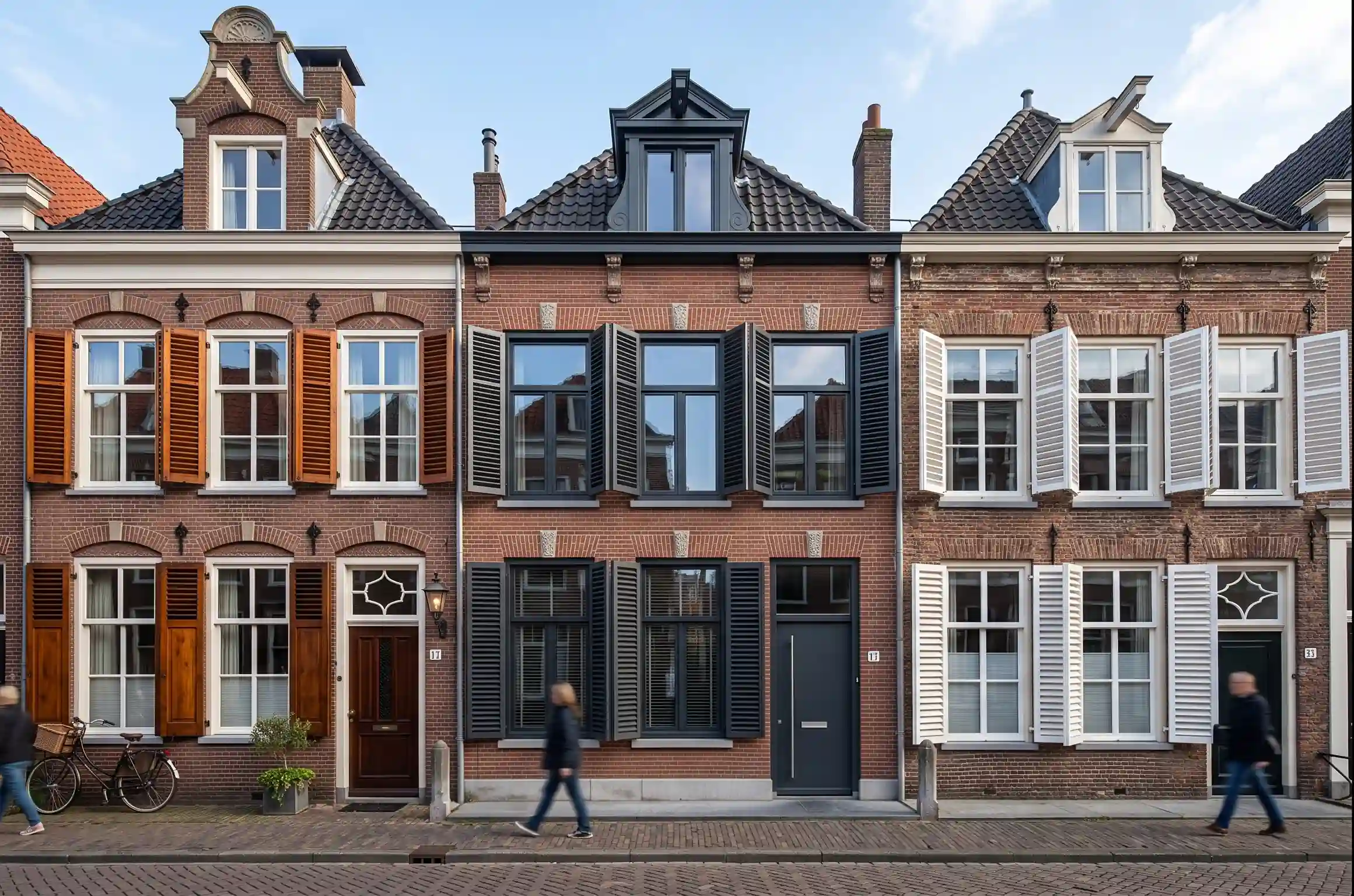
The material of your shutters not only determines the look of your façade, but also how much maintenance you’ll need to carry out over the coming years and how long the shutters will last. Wooden shutters offer the most authentic look and provide good insulation, but need to be painted every four to six years. Aluminium will last for decades without needing to be painted. UPVC falls somewhere in between in terms of price and maintenance.
Wooden shutters: appearance, types of wood and maintenance
Wood is the traditional material for shutters and instantly adds warmth and character to a façade. Not all types of wood are suitable for outdoor use: the type of wood determines how long the shutters will last without any problems.
At Shutters Inc., we use three FSC-certified hardwoods as standard: Meranti, Merbau and Bankirai. European oak and red cedar are also available on request. FSC certification means that the timber comes from responsibly managed forests — a factor to consider if sustainability plays a part in your decision.
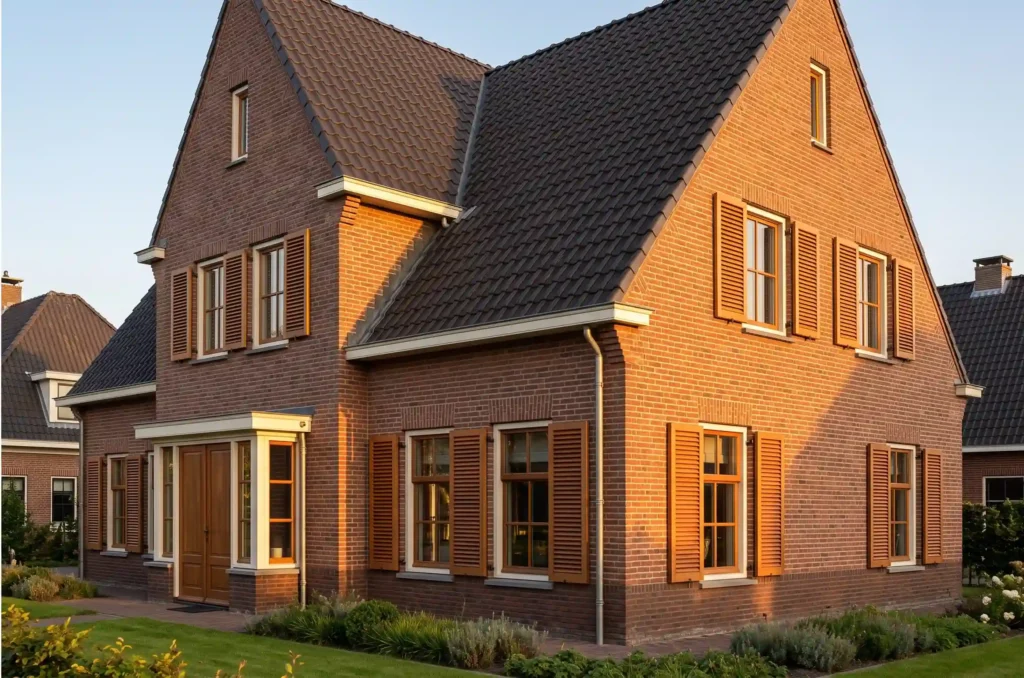
Meranti is the most commonly used hardwood for external shutters: moderately hard, easy to paint and stain, and resistant to changing weather conditions. Bankirai is harder and has a naturally higher resistance to moisture and mould, making it suitable for locations with higher rainfall or more shade. Merbau has a dark, deep colour and is naturally oily, which enhances its durability.
The downside of wood is the maintenance. Expect to paint or stain them every four to six years, depending on exposure to sun and rain. If you neglect this maintenance, the wood is more likely to crack and rot. With proper maintenance, hardwood shutters can last 20 to 30 years.
Aluminium shutters: low-maintenance and suitable for any climate
Aluminium shutters require virtually no maintenance once installed. The colour coating — a thermally cured powder coating — remains stable for decades without the need for repainting. Corrosion is not an issue, even in locations close to the coast or with high humidity.
In terms of appearance, aluminium shutters are more versatile than they used to be: wood-effect textures and colours are available, making them almost indistinguishable from wood when viewed from a distance. Any RAL colour is possible. Aluminium also retains its shape — it does not shrink or expand due to temperature changes, which is important for a tight seal.
This material provides less insulation than solid wood. If you primarily want to use shutters as a heat buffer, wood offers better insulation. Aluminium shutters are, on average, slightly more expensive to buy than wooden shutters of a similar size, but the lower maintenance costs over their lifetime more than make up for that difference in the long run.
Upvc shutters: budget-friendly and maintenance-free
Upvc (UPVC) shutters are the lowest-maintenance option and are often the cheapest to buy. They do not peel, rot or discolour, thanks to the UV protection built into the material itself. Washing them with water and mild soap is all the maintenance they require.
The wood-effect film on upvc shutters is now of good quality: from a distance, you cannot tell the difference from real wood. Up close, however, the texture is less convincing than that of solid wood. Upvc is less rigid than aluminium, which, with large dimensions — wide or tall shutters — can affect the flatness of the panel.
For homes where budget and ease of maintenance are more important than the most authentic wooden look, uPVC is a viable option.
Which material suits your home?
The choice depends on three factors: the style of the house, the desired level of maintenance and the budget. The table below provides a practical overview.
| Wooden shutters | Aluminium shutters | Upvc shutters | |
|---|---|---|---|
| Appearance | Most authentic, warmth | From modern to classic, flexible | Wood-effect finish available, less convincing up close |
| Maintenance | Paint every 4–6 years | Virtually none (just cleaning) | None (cleaning only) |
| Lifespan | 20–30 years with proper maintenance | 30–40 years | 20–30 years |
| Insulation | Good (solid wood) | Moderate | Moderate |
| Purchase price | Medium | Medium to high | Low to medium |
| Best match | Farmhouse, 1930s, listed building | Modern, new-build, low-maintenance | Budget-conscious, practical |
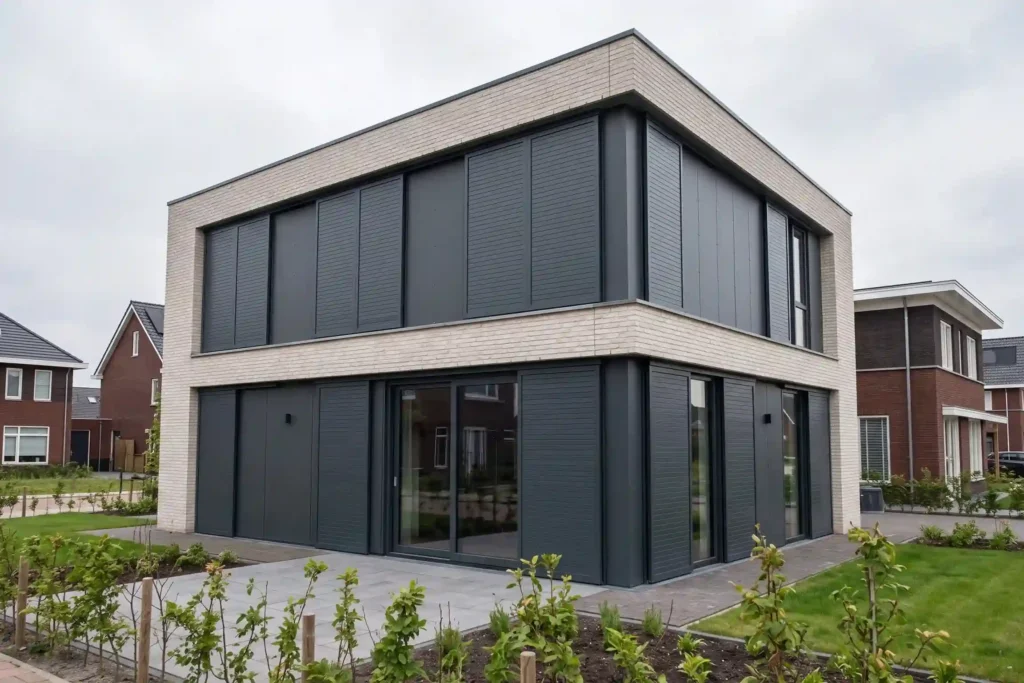
For an authentic farmhouse or a characteristic 1930s home, wood is the logical choice: the grain, the warmth of the material and the option to paint it in any RAL colour complement the character of this type of property. For a modern new-build home or a property where the owner wants low maintenance, aluminium is the best option. UPVC is suitable for homes where budget is a factor and the authentic wood-like appearance is less of a priority.
Not sure which material is right for your specific situation? Using Shutters Inc.’s online configurator, you can compare models and colours by material straight away.
Maintenance by material: what can you expect?
Maintenance requirements vary considerably depending on the material — and this has a direct impact on the total costs over the shutters’ lifetime.
Wood requires the most maintenance. For FSC-certified hardwood shutters such as Meranti or Bankirai, the general rule is: inspect them annually for cracks and peeling paint, and repaint or re-stain them every four to six years. If you put this off, you increase the risk of wood rot. A thorough sanding and repainting by a professional takes around one to two hours per shutter.
Once installed, aluminium shutters only require periodic cleaning. The powder coating on high-quality aluminium shutters is resistant to UV rays, salt and temperature fluctuations. An annual wash with lukewarm soapy water will keep the surface in good condition.
Upvc requires the same maintenance as aluminium: simply cleaning it is sufficient. Please note: lower-quality UPVC may discolour over the years, particularly following prolonged exposure to sunlight. When purchasing, ask about the material’s UV stabilisation.
Frequently asked questions
Which shutter material has the longest lifespan?
Under normal use, aluminium shutters will last 30 to 40 years without requiring any structural repairs. Hardwood shutters will last 20 to 30 years if well maintained. Upvc has a similar lifespan to wood, but is more dependent on the UV resistance of the material.
Are wooden shutters really more sustainable than upvc ones because of FSC certification?
FSC certification indicates the origin of the timber — responsible forest management — but says nothing about the product’s lifespan. An FSC-certified hardwood shutter is, however, a more environmentally conscious choice than UPVC, which is a petrochemical product. Furthermore, wood is biodegradable at the end of its lifespan.
Can I paint wooden shutters myself?
Yes, provided you use the correct primer and exterior paint and the wood is dry and clean before you start. For hardwoods such as Meranti, an oil- or alkyd resin-based product is suitable. Shutters Inc. supplies shutters as standard in your chosen RAL colour, after which you can repaint them yourself at a later date.
Are aluminium shutters also available in a wood-effect finish?
Yes. Aluminium shutters are available with a wood-effect powder coating or film in various wood textures. From a distance, they are almost indistinguishable from real wooden shutters. Up close, the difference is visible to those who know what to look for.
Which material is best for a listed building or a characterful home?
For listed buildings and homes with a conservation order, local authorities often stipulate that façade elements must be made from traditional materials. In most cases, wood is the only permitted material for shutters on such buildings. Check with your local authority to see if a planning permission is required before making your choice.
Are upvc shutters really maintenance-free?
In practice, cleaning is always necessary — dirt, algae and bird droppings will damage the surface over time. ‘Maintenance-free’ means that painting isn’t necessary, not that you never have to look after the shutters. A quick wash once a year is sufficient.
Are you still unsure about the right material for your situation? Request a no-obligation quote from Shutters Inc. — you’ll usually hear from us within 24 hours. Request a quote
In brief — Comparing shutter materials | Shutters Inc.
- Wood: the most authentic look, FSC-certified hardwood (Meranti, Merbau, Bankirai), maintenance required every 4–6 years, lifespan of 20–30 years
- Aluminium: low-maintenance, lifespan of 30–40 years, available in any RAL colour, including a wood-effect finish
- Upvc (UPVC): budget-friendly, maintenance-free (just cleaning), lifespan of 20–30 years
- Choice by property type: farmhouse/listed building → wood; new-build/modern → aluminium; budget-conscious → uPVC
- In-house production: Shutters Inc. manufactures all its shutters to measure in Haaksbergen, with delivery to the Netherlands, Belgium, Germany and France
- Service: free measurement, professional installation, and a response to your quote usually within 24 hours