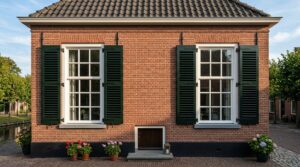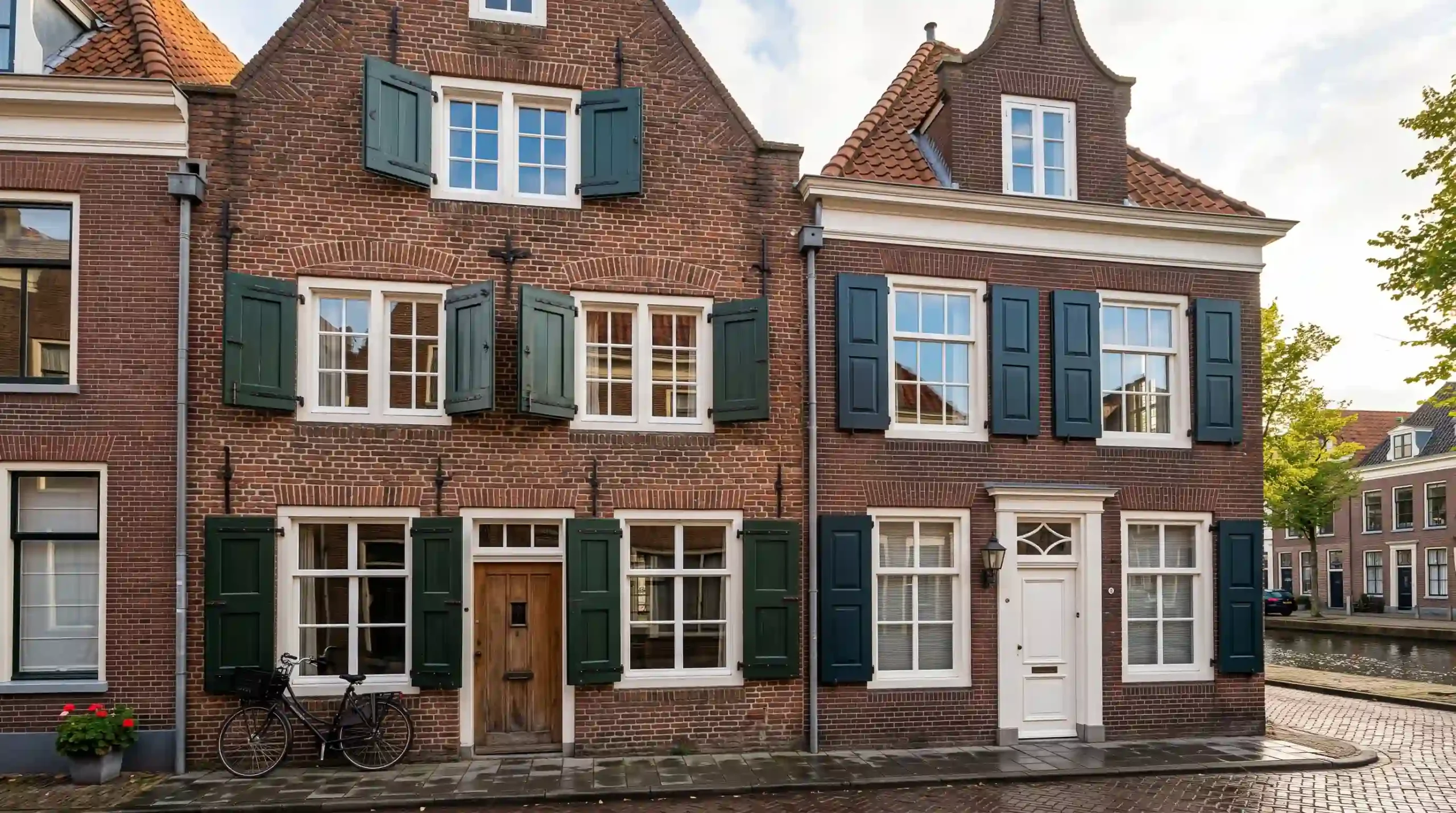
The difference between functional and decorative shutters is simple: functional shutters can be opened and closed, whilst decorative shutters cannot. That single difference affects the dimensions, the fittings, the installation and the price. Which type is best suited depends on what you wish to achieve: appearance, sun protection, privacy or a combination of these.
The difference in a nutshell: to close or not to close
Functional shutters are hinged to the window frame or the façade and can be closed completely across the window. They provide active sun protection, privacy and — in the case of panel shutters — extra insulation and burglary protection.
Decorative shutters, also known as ornamental shutters, are fixed to the façade next to the window. They cannot be opened or closed and serve a purely aesthetic purpose: they lend the façade depth, character and appeal. As they never need to be closed, they do not need to cover the window opening exactly.
This distinction may sound simple, but it has practical implications for dimensions, fittings and installation — and for how you can use them on a day-to-day basis.
What can you do with functional shutters?
Functional shutters give you day-to-day control over light, ventilation, privacy and protection. You can open them in the morning and close them in the evening or when the sun is too bright. With louvre shutters, you can control the amount of light entering by adjusting the angle of the slats without closing the shutter completely.
The practical benefits at a glance:
Sun protection — Closed louvre shutters keep direct sunlight out whilst still allowing ventilation. Panel shutters provide a complete seal and are more effective in extreme heat.
Privacy — Functional shutters provide genuine privacy as soon as they are closed, even in the evening when the lights are on inside.
Insulation — A solid-panel shutter creates an extra layer of air in front of the glass, which reduces heat loss in winter. The effect is measurable but modest — an additional measure alongside double glazing, not a replacement for it.
Burglary protection — Solid panel shutters with robust fittings — shutter locks and hold-open devices — make a window considerably more difficult to access. This is particularly relevant for ground-floor windows.
Important: functional shutters must be made to measure so that they cover the window opening exactly. Take measurements at several points — window frames are rarely perfectly straight.
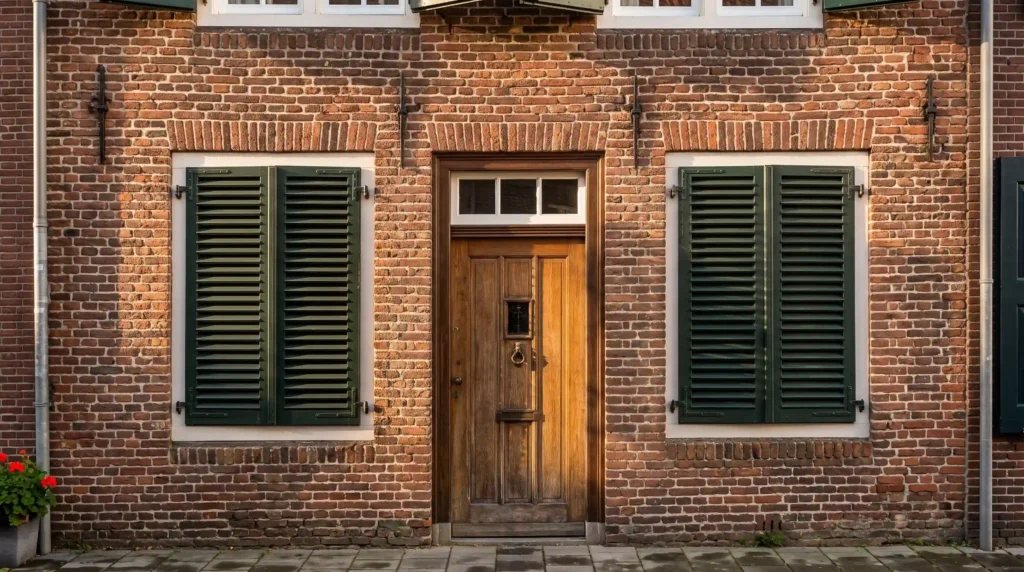
What can you do with decorative shutters?
Decorative shutters are primarily intended for the façade. They lend a home character, depth and charm — without the need for daily use. They are permanently fitted to the wall next to the window, using special mounting strips or brackets.
Advantages of decorative shutters:
Aesthetic appeal without the practical demands — Decorative shutters always look good. There is no risk of damage from wind, rattling or wear and tear on the hinges. They are ideal for homes where the appearance of the façade is the main priority but there is little need for functionality.
Flexible sizing — Decorative shutters do not need to cover the window opening exactly. This gives you more freedom with windows that are close together or where the depth of the window frame makes hinged installation difficult.
Simpler installation — Fixing shutters to the façade using strips is less complicated than fitting them with hinges. This usually results in lower installation costs.
Lower entry-level price — As no hinges, shutter locks or fasteners are required, the total cost of decorative shutters is lower than that of functional shutters of a similar size.
The downside is clear: decorative shutters offer no active sun protection, no privacy control and no protection against burglary. They are simply what they are: a visual enhancement to the façade.
Fittings and installation: what are the practical differences?
The main practical difference lies in the fittings and the method of installation.
Functional shutters are hung on hinges — pins and hangers — attached to the window frame or the façade. The pins are screwed into the window frame or the facing bricks; the hangers are attached to the shutter and hook into the pins. To close the shutters, shutter latches (centre latches) and shutter locks are required to keep the shutter closed or open in windy conditions. These fittings help determine the shutter’s lifespan and operation — high-quality fittings made of galvanised steel or stainless steel are preferable to basic versions.
Decorative shutters are screwed directly onto the façade using mounting strips or corner brackets. No hinges are required. The shutter is fixed in place and does not move. Installation is simpler and quicker, but does not allow the shutter to be opened at a later date.
At Shutters Inc., the fittings are always included in the quote and tailored to the weight and dimensions of the shutter.
When should you choose functional shutters, and when decorative ones?
Three questions to help you choose:
1. Do you actually want to be able to close the shutters? If sun protection, privacy or burglary prevention are factors, choose functional shutters. If it’s solely about the appearance of the façade, choose decorative shutters.
2. What is the design of your window frame or façade? Where there is a deep reveal (the space between the window frame and the façade), hinged fitting is simpler. For flat façades or windows that are close together, decorative fitting using strips may be more practical.
3. What is your budget? Due to the fittings and the precise dimensional requirements, functional shutters are more expensive than decorative shutters of the same type. If budget is a consideration and your functional needs are limited, decorative shutters are a sensible choice.
| Functional shutters | Decorative shutters | |
|---|---|---|
| Can be closed | Yes | No |
| Sun protection | Yes | No |
| Privacy | Yes | No |
| Burglary protection | Yes (with good fittings) | No |
| Dimensions | Made to fit the window opening exactly | Flexible |
| Fittings | Thumbs, handles, fastenings, locks | Mounting strips or brackets |
| Installation complexity | Higher | Lower |
| Starting price | Higher | Lower |
| Best match | Sun protection, privacy, security | The look of the façade, simplicity |
Still not sure? Use Shutters Inc.’s online configurator to compare models and colours and request a quote straight away.
Frequently asked questions
Can I have decorative shutters converted to functional ones at a later date?
Not without some modifications. Decorative shutters are not fitted with hinges and are often slightly smaller than the window opening. Making them functional requires new, made-to-measure shutters, plus the fitting of handles, latches and shutter fastenings. It is usually cheaper to make the right choice from the outset than to carry out alterations afterwards.
How do I measure for functional shutters?
Measure the window opening at at least two points for both width and height — window frames are rarely perfectly straight. Use the smallest measurement as your basis so that the shutter always fits within the opening. Shutters Inc. offers a free in-home measurement service, which helps to prevent sizing errors.
Are decorative shutters also available in aluminium or upvc?
Yes. Decorative shutters are available in wood, aluminium and UPVC. The choice of material affects the appearance and the level of maintenance required, but not the installation method — decorative shutters in all materials are fitted to the façade using strips or brackets.
Don’t decorative shutters rattle in the wind?
No. Decorative shutters are fitted flush against the façade and cannot move. Rattling is only a risk with functional shutters that have not been properly secured with shutter locks.
What type of shutter suits a listed property?
Check with your local council for the requirements. For listed buildings, the original style of shutters is often the deciding factor. In many cases, functional wooden shutters — panelled shutters or farmhouse shutters — are the only type permitted.
Are ornamental shutters the same as decorative shutters?
Yes, ‘ornamental shutters’ and ‘decorative shutters’ are two terms for the same concept: shutters that are permanently fitted and serve a purely aesthetic purpose.
Would you like to know which type is best suited to your home? Ask for advice with no obligation — you’ll usually hear from us within 24 hours. Request a quote
In brief — Functional or decorative shutters | Shutters Inc.
- Functional: opening and closing, sun protection, privacy, burglary prevention — made to measure, with hinges and shutter locks
- Decorative (ornamental shutters): permanently fitted, purely for aesthetic purposes — flexible sizing, fitted using strips
- Fittings: functional = thumb turn handles, hinges and locks; decorative = mounting strips or brackets
- Price: decorative shutters are cheaper due to fewer fittings and simpler installation
- Rule of thumb: if you need sun protection or privacy → functional; if it’s just for the look of the façade → decorative
- All types made to measure: Shutters Inc. manufactures in its own factory in Haaksbergen, free measurement service, delivery to the Netherlands, Belgium, Germany and France