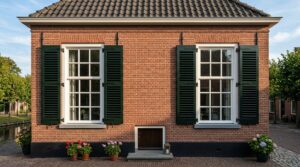
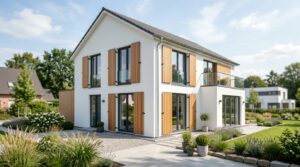
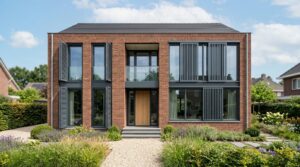
Louvre shutters let in light and air through angled slats and are ideal for sun protection. Panel shutters close completely and offer greater insulation, privacy and burglary protection. If you can’t decide, opt for a combination shutter: slats at the top and a solid panel at the bottom. Which type is best depends on your home, your priorities and the façade on which the shutters will be fitted.
What are louvre shutters?
Louvre shutters are characterised by their horizontal slats set within a fixed frame. The slats are set at a fixed angle — usually 45 degrees — which blocks direct sunlight whilst still allowing light and air to pass through. This makes louvre shutters the most popular choice for sun protection: you can open the windows without the sun shining directly in or passers-by being able to look inside.
The slats are available in three styles: recessed (the slat sits within the frame), flush (the slat is level with the frame) and projecting (the slat extends beyond the frame). The projecting variant provides the most pronounced shading effect and is typical of the classic, Mediterranean shutter style.
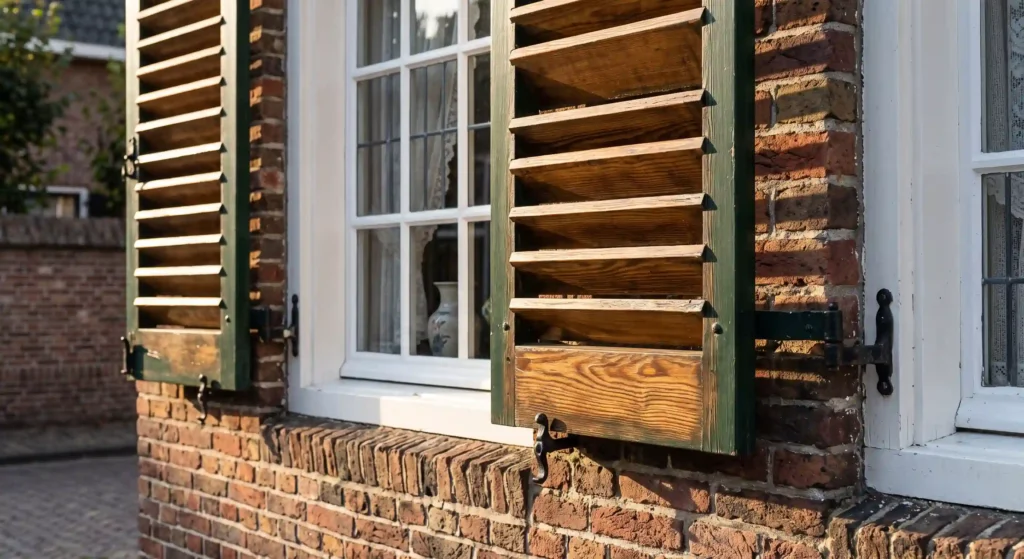
Louvre shutters are available in a range of materials: FSC-certified hardwood (Meranti, Merbau, Bankirai), aluminium and UPVC. With wooden louvre shutters, the slat thickness and angle can be fully customised to suit your requirements.
What are panel shutters?
Panel shutters consist of a hardwood or aluminium frame with a fully enclosed panel. No light enters when the shutter is closed — making panel shutters the best choice for insulation, blackout and burglary protection.
Because the panel forms a solid surface, it insulates better than slats: a solid panel shutter creates an extra layer of air in front of the glass, which reduces heat loss in winter and prevents overheating in summer. Solid wood panel shutters also absorb heat and cold and provide better sound insulation than thinner alternatives.
In terms of appearance, panel shutters are sleek and timeless. The panel can be fitted with a bevelled edge — a slanted finish — to create an extra sense of depth. A decorative motif can also be applied to the panel, such as the classic hourglass pattern typical of farmhouse shutters in Twente and the Achterhoek.
Shutters Inc. uses Meranti and Accoya as standard timber species for its wooden panel shutters — both retain their shape and dimensions in changing weather conditions.
Louvres or panel shutters: when should you choose which type?
Choosing between louvre and panel shutters comes down to three questions: do you want to let light in when the shutters are closed, how important is insulation, and what look does your façade require?
| Louvre shutters | Panel shutters | |
|---|---|---|
| Light entering when the shutters are closed | Yes — filtered light through slats | No — complete blackout |
| Ventilation when the shutters are closed | Yes — air circulation through the slats | No |
| Insulation | Moderate | Good — extra layer of air for the glass |
| Burglary protection | Moderate | Good — closed panel |
| Sound insulation | Limited | Better with solid wood |
| Sun protection | Excellent | Yes, but they provide complete blackout |
| Ideal application | Holiday home, sun protection, country home | Bedroom, street-facing, security, insulation |
| Interior style | Classic, Mediterranean, country-style | Classic, modern, timeless |
For a home where you want to keep the windows open during the day whilst still enjoying protection from the sun and prying eyes, louvre shutters are the logical choice. For a bedroom window facing the street, or a home where you want extra security at night, panel shutters offer greater strength.
Combi shutters: the best of both worlds
If you want to combine natural light with insulation, opt for a combination shutter. In a combination shutter, the upper section consists of louvres, whilst the lower section is a solid panel. The shutter’s mullion is usually positioned in line with the window frame’s mullion, ensuring the overall architectural harmony.
The advantage of a combination shutter is that the lower section, which is harder to reach, closes completely — preventing people from looking in at eye level — whilst the upper section allows light and air to pass through. This makes combination shutters popular for homes where privacy at street level is important but complete blackout is not required.
Wooden combination shutters can be made to measure at Shutters Inc., available in hardwood, aluminium and UPVC.
Which type suits your interior style?
In many cases, your interior style already points you in the right direction.
Farmhouses and country homes — The classic image of a Dutch farmhouse with shutters is the clamped farmhouse shutter or a panel shutter with an hourglass pattern. Louvered shutters also suit country homes but lend a slightly more southern character.
1930s homes and character properties — Both louvre and panel shutters are suitable for this type of property. Louvre shutters add warmth and movement to the façade; panel shutters create a calm, symmetrical appearance.
Modern new-build homes — Aluminium panel shutters in a sleek colour (anthracite, black, white) complement the architecture of modern homes. Aluminium louvre shutters are also an option but are less commonly chosen for sleek façades.
Listed buildings — Always check with your local council regarding the permitted types of shutters for a listed building. In most cases, the original shutter style takes precedence — for many listed buildings, this means wooden farmhouse shutters or panelled shutters.
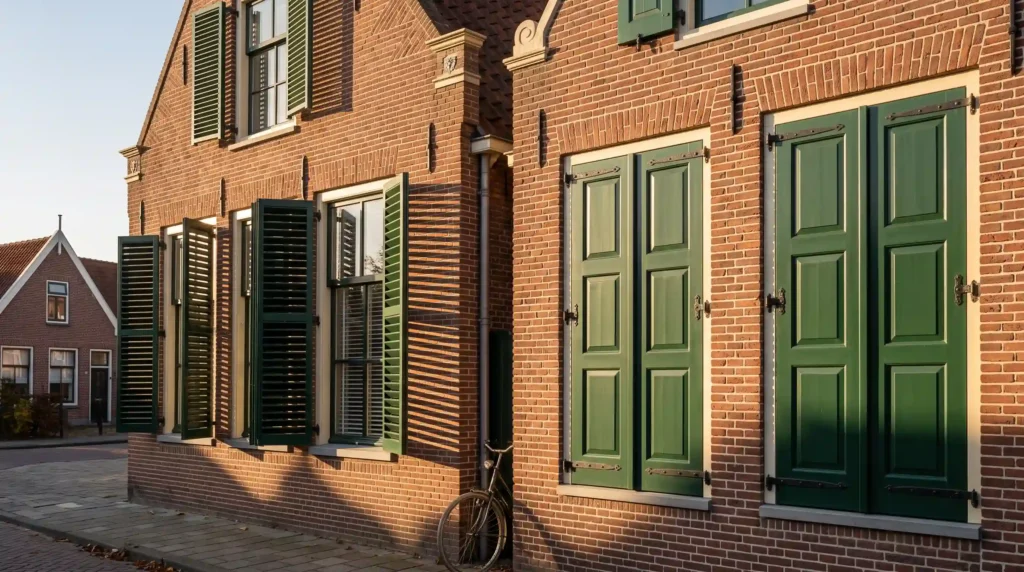
Still not sure? Using Shutters Inc.’s online configurator, you can compare models and colours straight away and get an idea of how the shutters will look on your façade.
Frequently asked questions
What is the difference between louvre shutters and panel shutters?
Louvre shutters have slats set within a frame. Window shutters — also known as classic shutters or clamped shutters — consist of vertical planks that are clamped together horizontally. Window shutters do not have slats and close completely, similar to panel shutters but with a different construction and appearance.
Are louvre shutters suitable for sun protection?
Yes. Louvre shutters are ideal for sun protection: the slats block out direct sunlight whilst allowing light and air to pass through to some extent. They are more effective than screens in strong winds and look more stylish than roller shutters.
Which type of shutter provides the best insulation?
Panel shutters provide better insulation than louvre shutters. The closed panel creates an extra layer of air in front of the glass, which reduces heat loss. Solid wood panel shutters also add a small amount of thermal mass.
Can I combine louvre and panel shutters in the same home?
Yes, that’s a common choice. Louvre shutters on living room windows for light and ventilation, panel shutters on bedroom windows for blackout and privacy. As long as the material, colour and fittings match, the façade will look consistent.
How much more do louvre shutters cost than panel shutters?
Due to their slats, louvre shutters are slightly more labour-intensive to manufacture than simple panel shutters of a similar size. The price difference is usually minimal — depending on the type of slat and finish. A combination shutter falls between the two in terms of price. Request a quote for an exact, bespoke comparison.
Are panel shutters also available in upvc?
Yes. Shutters Inc. supplies UPVC panel shutters, made entirely to measure. UPVC panel shutters are maintenance-free and available in any RAL colour or with a wood-effect finish.
Would you like to find out which type of shutter suits your home best? Request a no-obligation quote — we’ll usually get back to you within 24 hours. Request a quote
In brief — Louvered or panel shutters | Shutters Inc.
Configurator: view models and colours live at shuttersinc.nl/en/offerteformulier
Louvre shutters: slats, filtered light and ventilation when the shutters are closed, excellent for sun protection
Panel shutters: fully enclosed, best insulation and burglary protection, blackout
Combi shutters: slats at the top, panels at the bottom — a combination of light and privacy
Decision guide: louvres for sun protection and light control; panel shutters for bedrooms, street-facing windows and security
Home style: farmhouse/rustic → panel or farmhouse shutters; modern → aluminium panel; Mediterranean → louvre
All types made to measure: Shutters Inc. manufactures in its own factory in Haaksbergen, with delivery to the Netherlands, Belgium, Germany and France