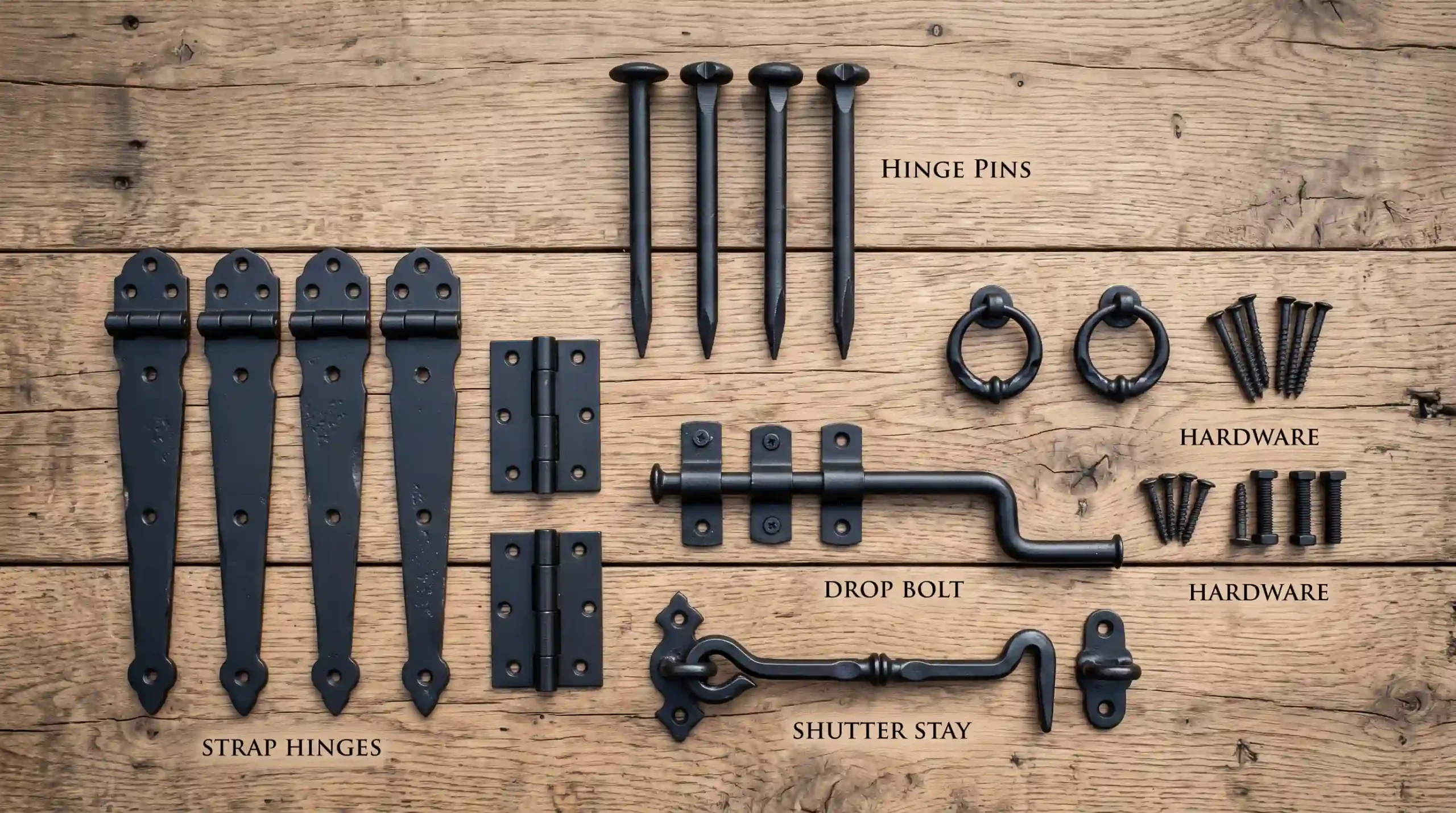
Shutter fittings are the hinges and locks used to hang, open, close and secure external shutters. It consists of four main components: pivots (the pin on which the shutter rotates), hinges (the hinged parts on the shutter), shutter locks (to keep the shutter closed) and shutter holds (to keep the shutter open). Choosing the right fittings helps determine how long your shutters will function properly and how they will still look in ten years’ time.
What are shutter fittings and what parts do they consist of?
Shutter fittings is the collective term for all the mechanical components required to fit and operate functional external shutters. For decorative shutters — ornamental shutters fixed to the façade — mounting strips or brackets are sufficient; these are not covered in this guide.
For functional shutters that can be opened and closed, the following components are available:
- Thumbs — the pin fixed to the façade or window frame on which the shutter pivots
- Hinges — the hinged parts attached to the hatch that hook into the thumb
- Hatch fastenings — the central fastening that locks the hatch in the closed position
- Hatch fasteners — the hook or clamp used to hold the hatch in the open position
- Spacers — spacers used when the façade is not flat or the fastener does not fit without a gap
Each component has its own function, and any component can become a weak link if it is not up to standard for the weight or size of the hatch.
Thumbs: plate thumbs, screw-in thumbs and mortise thumbs
The hinge pin is the pivot on which the shutter hangs. The choice of hinge pin type depends on the installation situation: is it being fitted to the wall, in the window frame, or in the masonry?
Surface-mounted hinges are fixed directly to the façade or external wall via a plate. This is the simplest method of installation and is suitable for situations where fitting within the window frame is not possible or desirable. Surface-mounted hinges are adjustable in depth, which makes installation easier on uneven façade surfaces.
Screw-in thumb turns are screwed directly into the window frame or the wall. They have a thread that is screwed into a pre-drilled hole. Screw-in thumb latches offer greater depth adjustment and provide a neater finish as no mounting plate is visible. They are the most commonly used type of thumb latch for hardwood window frames.
Masonry-set hinges are incorporated into the brickwork during construction. They are the strongest option but cannot be adjusted retrospectively. They are used almost exclusively in new builds or major renovations.
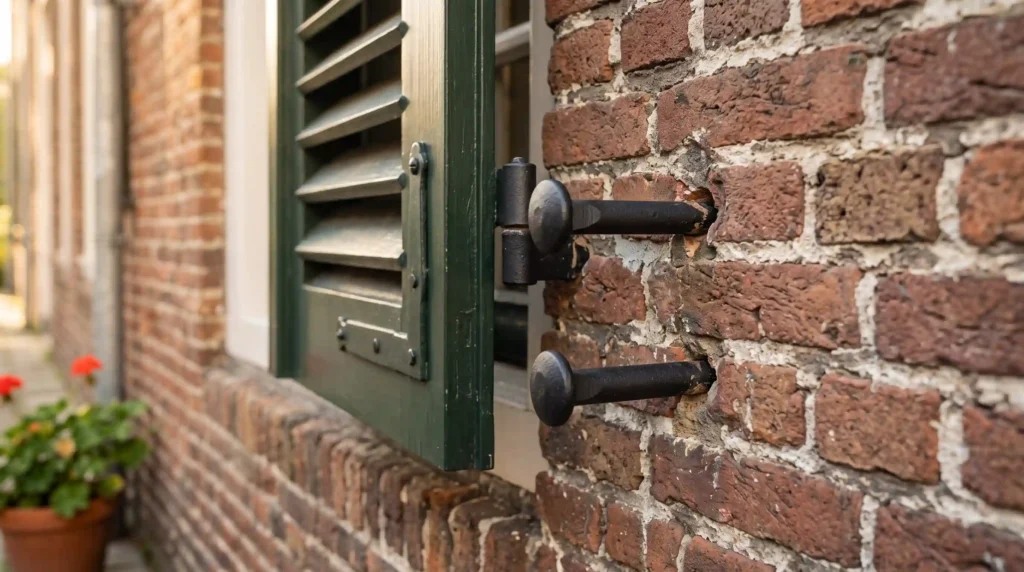
Hinges: the hinged part of the hatch
The hinge is the part attached to the shutter itself that hooks into the thumb. Together, the thumb and hinge form the hinge mechanism. The hinge also helps determine the appearance of the shutter: wrought-iron hinges with a pointed or crescent shape are typical of classic and rustic shutters; sleek hinges are better suited to modern aluminium shutters.
Hinges are available in various lengths — typically 30 mm, 50 mm and 70 mm — depending on the thickness of the shutter profile and the desired projection of the shutter from the façade. Heavier wooden shutters require longer and more robust hinges than lightweight upvc shutters.
A rule of thumb: use at least two hinges per shutter for shutters up to 80 cm high, three hinges for shutters between 80 and 150 cm, and four hinges for shutters over 150 cm high. For louvred shutters — which, due to their construction, may be heavier than panel shutters of a similar size — an extra hinge is recommended.
Hatch fastenings and hatch locks: keeping them open and closed
Two components ensure that a functional hatch can remain both closed and open: the hatch latch and the hatch lock.
Shutter fastenings — also known as centre fastenings or overlapping fastenings — lock the shutter in the closed position. The fastening is fitted in the centre of the shutter and engages with the window sill, the brickwork or a counter-piece in the façade. A good shutter fastening keeps the shutter closed even under wind pressure and prevents rattling. For heavy or large shutters, two locks — one at the top and one at the bottom — are recommended to ensure an even seal.
Shutter retainers — also known as shepherd’s heads or shutter pivots — hold the shutter in the open position so that it cannot be blown shut by the wind. They are fitted to the façade at a height where the arm of the hold-open device catches the shutter in the open position. Available with 75 mm, 95 mm and 125 mm arms, depending on how far the shutter protrudes from the façade.
A hatch without a hold-open device that slams in the wind will damage itself, the frame and the fittings in no time. The hold-open device is therefore not an accessory but an essential part of any functional hatch system.
Which fittings are suitable for which type of hatch?
The choice of fittings depends on the type of hatch, the material and the weight. The table below provides a practical overview.
| Shutter type | Material | Recommended fittings |
|---|---|---|
| Louvre shutter, standard | Hardwood | Screw-in thumb latches, 3 hinges per hatch, centre fastener, locking device |
| Louvre shutter, large (>120 cm) | Hardwood | Reinforced screw-in thumbscrews, 4 latches, 2 fasteners, locking device |
| Panel shutter | Hardwood | Screw-in or plate-mounted thumb latches, 2–3 hasps, centre fastener, locking device |
| Farmhouse shutter / hinged | Hardwood | Plate-type thumbs or screw-in thumbs, 3 hooks, centre clasp, fastener |
| Louvre shutter | Aluminium | Screw-in thumb fasteners, 2–3 hooks (lighter), centre fastener, locking device |
| Louvre shutters / panel shutters | UPVC | Plate thumb studs or mounting strips, 2 hinges, centre clasp or strip |
| Decorative shutter | All materials | Mounting strips or brackets — no hinges |
At Shutters Inc., fittings are always included in the quote and tailored to the specific shutter. The shutter fittings — including thumbturns, hinges, shutter latches and shutter locks — form part of the complete bespoke process.
Material and finish: galvanised, stainless steel or bronze?
Shutter fittings are fitted outdoors and are exposed to rain, frost and UV rays. The choice of material determines how long the fittings will last without rusting or discolouring.
Galvanised steel with a black powder coating is the most commonly used finish for classic and rustic shutter fittings. The zinc coating protects against rust; the powder coating gives the characteristic matt black colour that complements hardwood shutters. Lifespan with proper maintenance: 15–25 years. Drawback: if the coating is damaged, rust may form, particularly at the fixing points.
Stainless steel is the most durable option and requires no maintenance of the metal itself. Suitable for coastal areas or homes with high humidity where ordinary steel corrodes more quickly. Stainless steel fittings are generally more expensive but will easily last 30–40 years.
Bronze has a warm, dark colour with a patina that becomes more beautiful over time. It is used less frequently but is an excellent choice for authentic and heritage properties. Bronze is corrosion-resistant and low-maintenance.
Do you live in a listed building or a conservation area? If so, be sure to read our comprehensive guide to shutters for listed buildings: planning permission, historical detailing and exact reconstruction.
Frequently asked questions
How many thumb latches and hinges do I need per shutter?
As a rule of thumb: 2 hinges per shutter up to a height of 80 cm, 3 hinges for 80–150 cm, and 4 hinges above 150 cm. One thumb is required per hinge point. For heavy hardwood louvre shutters, always use one hinge more than the minimum.
Can I fit loft door fittings myself?
Yes, provided you’re handy with tools and carry out the fitting carefully. The most important step is ensuring the handles are positioned correctly — a handle that’s crooked or fitted too deeply will result in a shutter that doesn’t close properly or sags. Shutters Inc. provides professional fitting, including the fittings, as part of the complete bespoke service.
What are shims and when are they needed?
Spacer blocks are spacers that are placed between the centre fastener and the hatch or façade when the fastener does not fit properly due to an uneven façade surface or a frame that is not square. They ensure an even fit without any play.
How do I maintain shutter fittings?
Lubricate hinges and thumb latches twice a year with a drop of machine oil or silicone spray. Check annually for rust, loose screws and wear and tear on the fastening. Replace worn parts in good time — a broken latch or fastening will cause the hatch to rattle and damage the wood.
Which fittings are suitable for aluminium shutters?
Aluminium shutters are lighter than hardwood shutters and place fewer demands on the fittings. Screw-in thumb turn handles in stainless steel or galvanised steel, combined with matching hinges and a standard centre lock, are suitable for most aluminium louvre and panel shutters.
Does Shutters Inc. also supply separate shutter fittings?
Yes. In the hatch fittings section of the website, thumb turn handles, latches, fasteners and locking devices are available separately, including as replacements for existing fittings from other manufacturers.
Not sure which fittings are right for your shutters? Ask for advice with no obligation — we’ll usually get back to you within 24 hours. Request a quote
In brief — Shutter fittings guide | Shutters Inc.
- Thumbs: the pivot pins in the façade or window frame — plate thumb (on wall), screw-in thumb (in window frame), brickwork-mounted thumb (in brickwork)
- Hinges: the hinged part on the hatch — 2 per hatch up to 80 cm, 3 for 80–150 cm, 4 for over 150 cm
- Hatch fastenings: secure the hatch in the closed position — centre fastening on the window sill or in the masonry
- Hatch fasteners: keep the hatch open — shepherdess heads in 75/95/125 mm
- Material: galvanised steel (standard), stainless steel (coastal/high humidity), bronze (authentic/heritage)
- Fittings at Shutters Inc.: always included in the quote, tailored to the type and weight of the shutter
- Available separately: thumb studs, hinges, fastenings and retainers, also sold individually as replacements