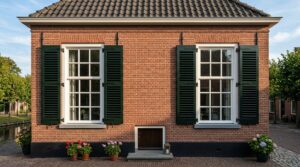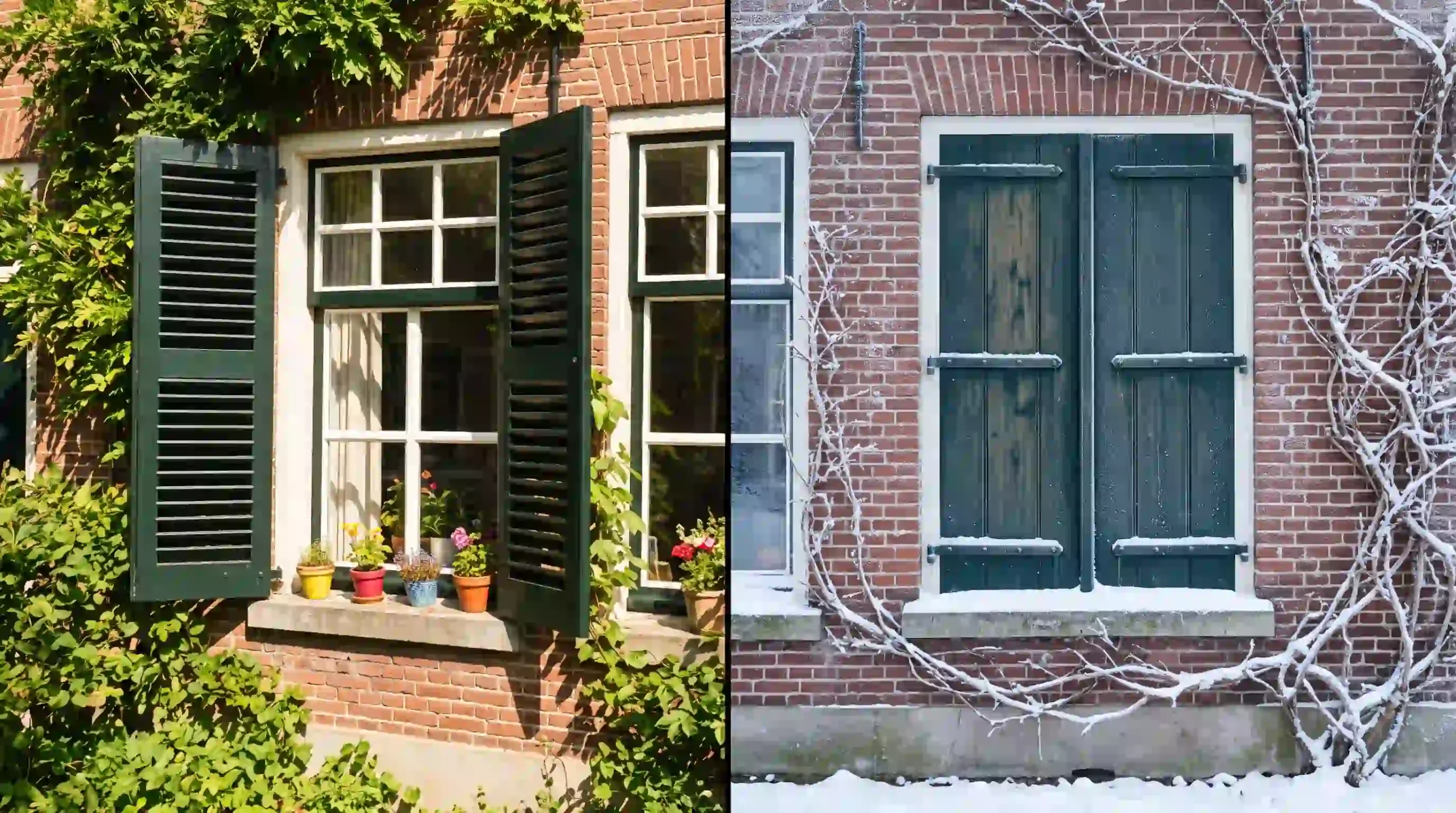
Solid panel shutters create an extra layer of air in front of the glass, which reduces heat loss in winter and prevents overheating in summer. Louvered shutters work excellently as sun protection but offer less insulation because the slats allow airflow. The greatest insulation benefits can be achieved in homes with single-glazed windows: solid timber panel shutters bring the insulation value of single glazing up to a level comparable to that of high-performance (HR) glass.
How do external shutters work as insulation?
External shutters provide insulation through a simple physical principle: a closed shutter creates a layer of still air between the shutter and the glass. Still air is a poor conductor of heat — it slows down heat transfer in both directions. In winter, this keeps the heat in; in summer, it keeps the heat out.
The insulation value of a closed external shutter depends on three factors: how the shutter fits against the window frame (seal against draughts), the thickness and material of the shutter, and the size of the air gap between the shutter and the glass.
A solid timber panel shutter that fits snugly against the window frame provides the best draught protection of all shutter types. The timber itself also has a certain thermal mass: it absorbs heat during the day and releases it slowly — this helps to mitigate temperature spikes on the outside of the glass.
Closed shutters are an effective way of insulating your home in winter: they improve insulation and minimise heat loss through gaps and joints, which saves on heating costs and increases comfort.
When closed, external shutters limit heat loss and cold radiation from the glass in the windows. Condensation does not usually occur with external shutters.
Shutters as sun protection: summer and shading
In summer, external shutters work in the opposite way: they keep the sun’s rays out before they reach the glass. That is precisely why external sun protection — shutters, screens, awnings — is more effective than internal sun protection (curtains, blinds): the heat is kept out rather than let in and then dampened.
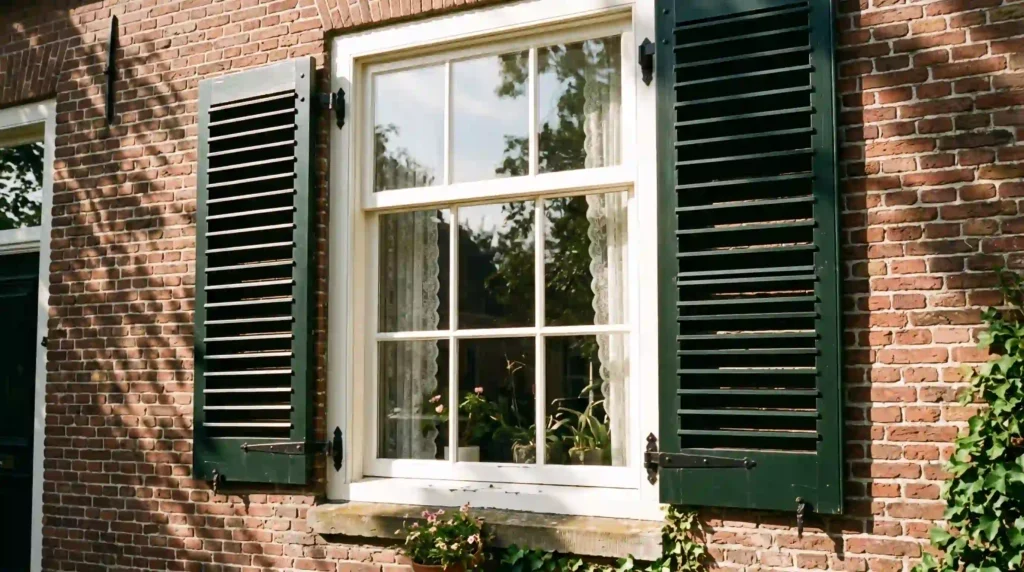
Louvre shutters offer the best sun protection of all shutter types. The angled slats block direct sunlight whilst still allowing ventilation. You can open the windows without the sun shining directly in. With the louvre shutters closed and the window open, cool air circulates whilst the sun stays outside — a natural cooling principle that has been used in Mediterranean countries for centuries.
Panel shutters close completely and are therefore highly effective as sun protection — but also for blocking out light. They are ideal for bedrooms on the sunny side of the house where the morning sun wakes you up too early.
Combi shutters combine both functions: the upper louvre section allows filtered light through, whilst the lower panel section provides a complete seal at eye level.
Which type of shutter provides the best insulation?
The insulation value varies greatly depending on the type of shutter. An honest overview:
| Shutter type | Winter insulation | Sun protection in summer | Ventilation when the shutters are closed |
|---|---|---|---|
| Solid wood panel shutters | ★★★★★ — best draught-proofing + thermal mass | ★★★★★ — completely sealed | No |
| Wooden farmhouse shutter (clamped shut) | ★★★★ — good fit, less solid | ★★★★ — fully closed | No |
| Wooden louvre shutter | ★★ — slats allow air to pass through, limited insulation | ★★★★★ — excellent shading performance | Yes |
| Aluminium panel shutter | ★★★ — good draught-proofing, lower thermal mass | ★★★★ — fully closed | No |
| Upvc panel shutter | ★★★ — effective draught-proofing | ★★★★ — fully closed | No |
| Combi-shutter (louvre + panel) | ★★★ — the panel section provides insulation, the louvre section does not | ★★★★ — partially closed | Yes (louvre section) |
Conclusion: for maximum insulation benefits, a solid timber panel shutter is the best choice. For sun protection whilst maintaining ventilation, a louvre shutter is superior. If you want both, opt for a combination shutter or mix and match shutter types for each window.
Shutters and energy saving: what can you expect?
It’s important to have realistic expectations here — there are sometimes exaggerated claims circulating about the energy savings offered by shutters.
With single glazing, the insulation benefits of closed panel shutters are considerable. Single glazing with closed shutters is comparable to high-performance (HR) glazing in terms of insulation value. For homes with historic single glazing — listed buildings, pre-war properties — well-fitting external shutters are therefore one of the most effective and least invasive insulation measures.
With double glazing or high-performance (HR) glass, the additional insulation benefit provided by shutters is more modest. The glass itself already insulates well; the layer of air that the shutter adds therefore has a relatively smaller effect. Shutters remain valuable for sun protection and privacy — but anyone wishing to use them purely for energy savings with modern glazing would be well advised to adjust their expectations.
Practical use plays a part in determining the savings. Shutters only provide insulation when closed — and external shutters cannot usually be operated from the inside. Those who consistently close them in the evenings during winter and during the day on hot summer days will achieve the greatest savings. Those who leave them open for decorative purposes or forget to close them will achieve little.
Grant: external shutters are not eligible for the ISDE grant. See our price guide for shutters for an overview of costs and grant options.
Shutters as an alternative to roller shutters
External shutters and roller shutters are often compared as insulation and sun protection solutions. Both work on the same principle — external sun protection — but there are practical differences.
| External shutters (window shutters) | Roller shutters | |
|---|---|---|
| Operation | From the outside (unless they are electric) | From the inside (manual or electric) |
| Insulation value | Good for panel shutters | Well-sealed aluminium roller shutters |
| Sun protection | Excellent (louvre) / full (panel) | Full |
| Appearance | Architectural, full of character | Functional, less conspicuous |
| Maintenance | Painting every 4–6 years (wood) / none (aluminium/UPVC) | Maintenance of the mechanism, cleaning the slats |
| Bespoke | Fully made to measure | Standard or made to measure |
| Listed buildings | Often the only permitted option | Rarely permitted on listed buildings |
For homes with architectural or historical value, external shutters are almost always the better choice — both in terms of appearance and feasibility when it comes to planning permission. For modern homes where operation from the inside is a priority, a roller shutter may be more practical.
Frequently asked questions
Do louvre shutters also provide insulation?
Louvre shutters provide limited insulation. The slats always allow some air to circulate, which means that the layer of still air that traps heat is less effective than with a closed panel shutter. Louvre shutters are excellent for sun protection; panel shutters are the better choice for winter insulation.
Are there any grants available for external shutters as an insulation measure?
No. External shutters are not eligible for the ISDE grant from the Netherlands Enterprise Agency. For listed buildings, the local council may offer a grant for façade renovation — check with your local council. See also our price guide for shutters.
Do external shutters also work with double glazing?
Yes, but the additional insulation benefit is less than with single glazing. With double glazing or high-performance (HR) glazing, shutters remain valuable for sun protection, blackout and privacy — the insulation benefit is an added bonus, not the main reason for purchasing them.
Do I need to close the shutters every evening to maximise the insulation benefits?
For maximum insulation in winter: yes. Closed shutters reduce heat loss at night when the outside temperature is at its lowest and the thermal load is at its highest. During the day in cloudy winter weather, closing them has less effect — as daylight and heat radiation are limited at such times.
Can external shutters also reduce noise?
To a limited extent. A closed, solid timber panel shutter dampens sound thanks to the mass of the timber and the extra layer of air. The effect is less than that of soundproof glass, but for homes on a busy road or near a railway line, it can provide a noticeable improvement.
What are the insulation benefits of shutters in a listed building with single-glazed windows?
In listed buildings where double glazing is not permitted, well-fitting wooden external shutters are one of the most effective insulation measures. They can increase the insulation value of single glazing to a level comparable to high-performance (HR) glass — without compromising the historic character of the building. The Sustainable Heritage Toolkit explicitly recommends external shutters as a sustainable measure for historic buildings.
Would you like to know which type of shutter is best suited to your situation — for sun protection, insulation or both? Request a no-obligation consultation — you’ll usually hear from us within 24 hours. Request a quote
In brief — Shutters for insulation and sun protection | Shutters Inc.
- Insulation principle: closed shutter = layer of still air in front of the glass = less heat loss in winter, less heat gain in summer
- Best insulation: solid timber panel shutters — best draught-proofing + thermal mass
- Best sun protection: louvre shutters — block direct sunlight whilst allowing ventilation
- Single glazing: a closed panel shutter provides insulation comparable to that of high-performance glass
- Double glazing: reduced insulation benefits; shutters remain valuable for sun protection and blackout purposes
- Grant: external shutters are not covered by the ISDE scheme; a local authority heritage grant may be available
- Listed building: external shutters are the most effective and least invasive insulation measure for single-glazed windows
- In-house factory: Shutters Inc. Haaksbergen — bespoke panel shutters and louvre shutters for a perfect fit