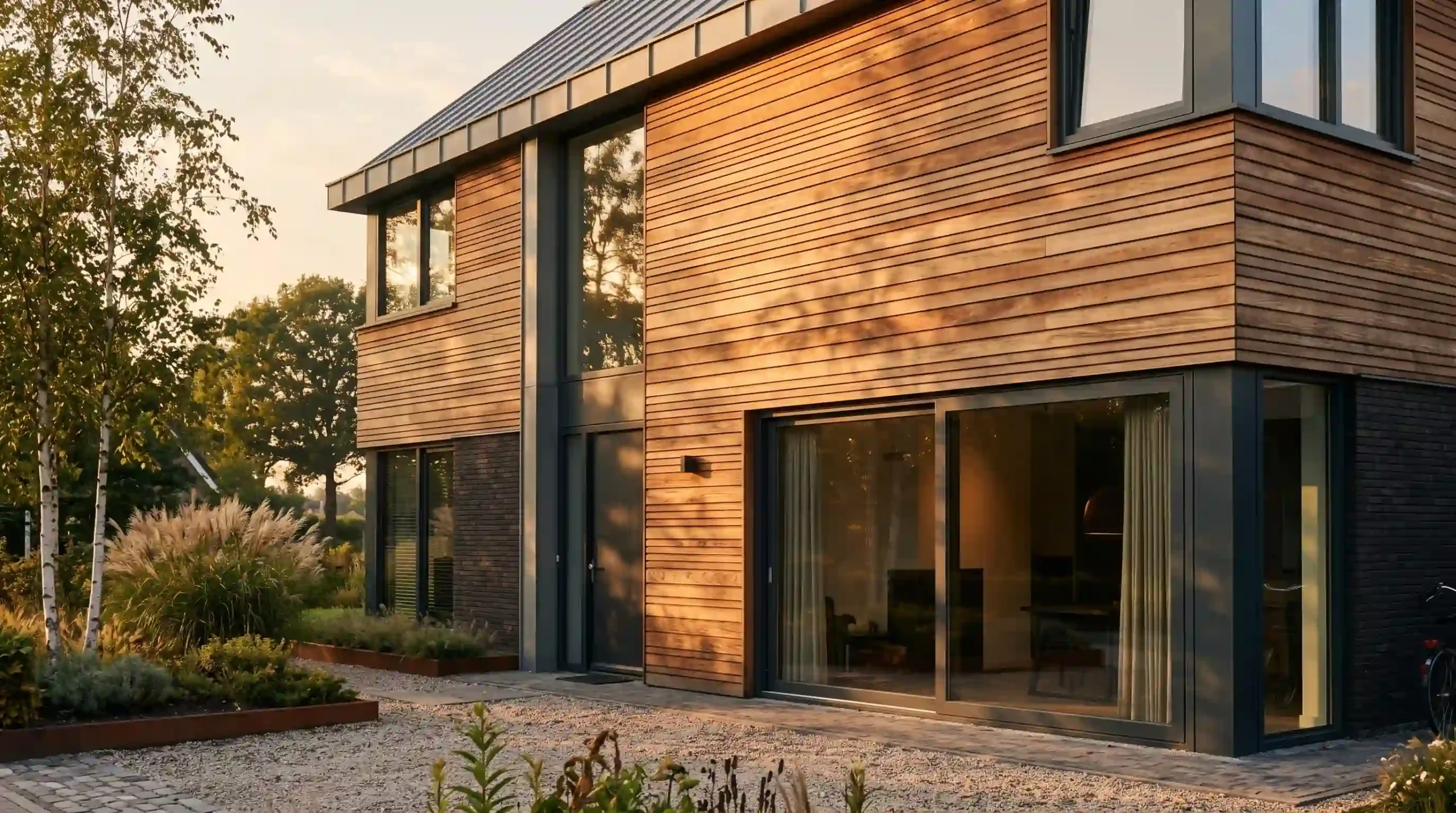
Wooden cladding gives a home warmth, character and a natural look that no other material can match. Choosing the right type of wood determines how long the cladding will last and how much maintenance you’ll need to carry out in the years to come. FSC-certified hardwood is the most sustainable option: stable, dimensionally stable and resistant to changing weather conditions. Combining cladding with wooden shutters made from the same material creates a façade that looks like a single, cohesive whole.
What is timber cladding?
Wooden cladding consists of profiled wooden planks or battens that are fixed to the outside of a building on a batten framework. The planks form a protective and decorative outer layer that shields the underlying façade from rain, wind and UV radiation.
Cladding can be installed in two ways:
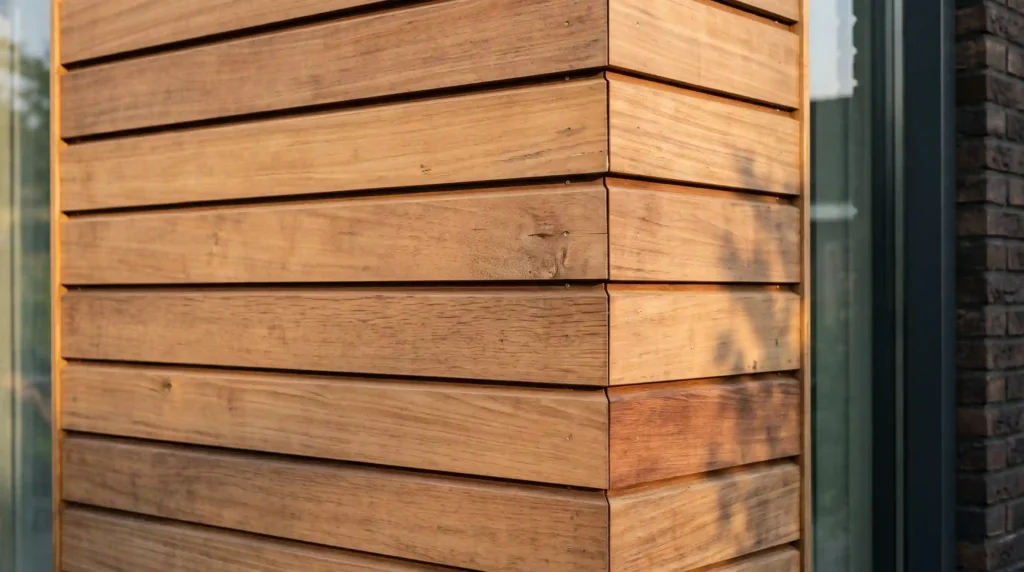
Horizontal — the most classic application. Horizontal boards create a calm, traditional look that suits country homes, farmhouses and 1930s properties well. Popular profiles include rebated (overlap), channel siding (groove) and block profile.
Vertical — creates a more modern, sleeker look and is popular for new builds and architecturally distinctive homes. Vertical slats make the façade appear taller. An open-slatted façade (with gaps between the slats) also provides ventilation behind the cladding.
The choice between horizontal and vertical is partly a matter of taste and partly an architectural consideration: vertical cladding on a low-rise building can make it appear taller; horizontal cladding on a tall building makes it look narrower and more compact.
Which types of wood are suitable for external cladding?
Not every type of wood is suitable for long-term outdoor use. The façade is one of the most demanding applications: the wood is constantly exposed to rain, frost, UV radiation and temperature fluctuations. There are three common categories:
FSC-certified hardwood is the most sustainable choice for cladding. Hardwoods such as Meranti, Merbau and Bangkirai are naturally dense and contain oils that promote moisture resistance and mould resistance. They fall into durability class 1 or 2, meaning they will last for decades in outdoor applications without the need for chemical treatment. The FSC label guarantees that the timber comes from responsibly managed forests.
Thermally modified timber — native timber (spruce, ash, ayous) that has been treated with heat and steam. The modification process significantly improves dimensional stability and durability. A good alternative to tropical hardwood; weathers to a silvery-grey colour over time.
Native softwoods (Douglas fir, larch, Siberian larch) are more affordable but require more maintenance. Douglas fir is naturally fairly durable; larch is denser and more durable than spruce but less so than hardwood. Both are excellent choices for those who prefer European timber and do not mind the wood weathering over time.
| Type of wood | Origin | Durability class | Maintenance | Ageing |
|---|---|---|---|---|
| Meranti (FSC) | Asia | 2 | Moderate | Yes, grey-brown |
| Merbau (FSC) | Asia | 1 | Little | Yes, silver-grey |
| Bangkirai (FSC) | Asia | 1 | Little | Yes, silver-grey |
| Larch | Europe | 3 | Moderate | Yes, silver-grey |
| Douglas fir | Europe/USA | 3–4 | Regularly | Yes, grey |
| Thermo-treated spruce/ash | Europe | 2–3 | Little | Yes, silver-grey |
Advantages and disadvantages of wooden cladding
Advantages
Wooden cladding has a natural warmth and appearance that composite, aluminium or upvc cannot match. Every piece of wood is unique due to its grain pattern and colour variations. Wood is a renewable and biodegradable material — at the end of its life, it is 100 per cent recyclable. FSC-certified hardwood also has a low carbon footprint when the wood comes from well-managed forests.
Wood is easy to work with: profiles, dimensions, finishes and colours are fully customisable. The material combines well with other cladding materials such as brickwork, render and zinc.
Disadvantages
The main drawback of wooden cladding is the maintenance it requires. Treated wood needs a fresh coat of paint or a new stain every three to five years. Untreated wood weathers — which is a desirable effect for many people — but it requires regular cleaning to prevent algae and moss from forming.
Wood can shrink and expand in response to temperature changes. With cheaper types of wood or incorrect installation, this can lead to warping or cracking. FSC-certified hardwood and thermally modified timber are much more stable than standard softwood in this respect.
Fire safety is an important consideration when using timber cladding. For new builds and renovations, building regulations (the Building Decree) apply regarding the fire resistance class of cladding materials. If in doubt, ask your builder or architect for advice.
Maintenance: what does wooden cladding require?
The maintenance regime depends on the type of wood and the desired finish.
Untreated (natural weathering) — the wood weathers within a few months to develop a silver-grey or grey-brown patina. This process is irreversible without sanding. Annual cleaning with a mild soapy solution is sufficient to prevent algae and moss. No paint or stain required.
Oiled or stained finish — the natural colour of the wood remains visible for longer. Re-treat every two to four years with the same oil or stain. Do not remove old layers completely — touching up is easier than replacing the cladding entirely.
Painted finish — fully opaque exterior paint in the desired RAL colour. Lifespan of approximately five to seven years for a high-quality exterior paint. Sanding and priming are required for a complete re-coating.
FSC-certified hardwoods (Meranti, Merbau, Bangkirai) are naturally oily. Use an alkyd or resin oil-based primer for the best adhesion — standard water-based primers do not adhere as well to the smooth hardwood surface.
Combining timber cladding with window shutters
This is the aspect that no cladding supplier covers — and precisely where good façade design makes all the difference.
Anyone opting for wooden cladding has the opportunity to design the entire façade as a single, coherent whole: cladding, window frames, shutters and fittings all in the same material, the same colour and with the same character.
Why this works
FSC-certified hardwoods used for cladding — Meranti, Merbau, Bangkirai — are exactly the same woods that Shutters Inc. uses for bespoke window shutters. This means that cladding and shutters share the same wood structure, the same colour development over the years and the same maintenance regime. The façade will either weather as a whole or retain its colour as a whole — depending on the chosen finish.
Practical benefits of combining the two
A façade with timber cladding and timber shutters made from the same type of wood and in the same colour requires less colour coordination and creates a more harmonious, professional appearance than when the cladding and shutters are made from different materials or in different colours.
Shutters also add depth and create shade on the façade — something that flat cladding alone cannot achieve. Open louvre shutters cast a pattern of slats onto the façade; panel shutters provide an architectural frame for the window openings.
Shutters Inc. manufactures fully bespoke wooden shutters from FSC-certified hardwoods — Meranti, Merbau and Bankirai — in any RAL colour or natural finish of your choice. Our in-house factory in Haaksbergen enables us to tailor shutters precisely to the cladding of your project, whether it’s a renovation project or a new-build home.
Guide prices for timber cladding
The cost of wooden cladding varies considerably depending on the type of wood, the profile and the installation method. As a guide:
| Type of wood | Guide price for materials (per m²) | Maintenance |
|---|---|---|
| Softwood (Douglas fir, larch) | € 30 – 55 | Regularly |
| Thermally modified timber | € 55 – 85 | Little |
| FSC-certified hardwood (Meranti, Bangkirai) | € 65 – 110 | Low to moderate |
Installation not included. Installation costs vary depending on the project and region; expect to pay €30–60 per m² for professional installation, including the battens.
Wooden cladding is more expensive to buy than upvc or composite, but with proper maintenance it will last for 30 to 50 years — which significantly reduces the annual cost.
Frequently asked questions
How long does wooden cladding last?
FSC-certified hardwood (Meranti, Merbau, Bangkirai) will last 30 to 50 years with proper maintenance. Thermally modified timber lasts 25 to 40 years. Softwood (Douglas fir, larch) lasts 15 to 25 years with regular painting or staining.
Is timber cladding durable?
FSC-certified hardwood is the most sustainable option: the timber comes from responsibly managed forests, is biodegradable and requires no chemical preservation for outdoor use. Thermally modified native timber is a good alternative that does not originate from tropical regions.
Do I need to apply for planning permission for wooden cladding?
For most homes in the Netherlands, no planning permission is required to clad the façade, provided that the appearance of the property is not significantly altered. However, an environmental permit is required for listed buildings, protected townscapes or properties subject to a building regulations designation. Please consult your local council before starting work.
Can timber cladding be combined with aluminium shutters?
Yes. Wooden cladding also combines well with aluminium shutters — for example, if you want the look of wood on the façade but wish to keep the shutters low-maintenance. The colour of the aluminium shutters (powder-coated) can be matched to the colour of the cladding. This creates a cohesive look, even though the materials are different.
Does wooden cladding always weather?
Untreated wood always weathers — this is a natural process caused by UV radiation and moisture. How quickly it weathers and the shade it takes on depend on the type of wood. To prevent or slow down weathering, you should treat the cladding with a UV-resistant oil or stain. Restoring wood that has already greyed to its original colour requires intensive sanding.
What is the difference between rebated cladding and channel siding?
Rabat is a profile in which each plank overlaps the one below it, similar to roof tiles. It gives a classic, rustic look. Channel siding has a groove at the top and a lip at the bottom, and the boards fit tightly together to create a flatter, sleeker façade. Both are popular profiles for horizontal timber cladding.
Are you looking for wooden window shutters that complement your cladding? Request a no-obligation quote from Shutters Inc. — you’ll usually hear from us within 24 hours. Request a quote