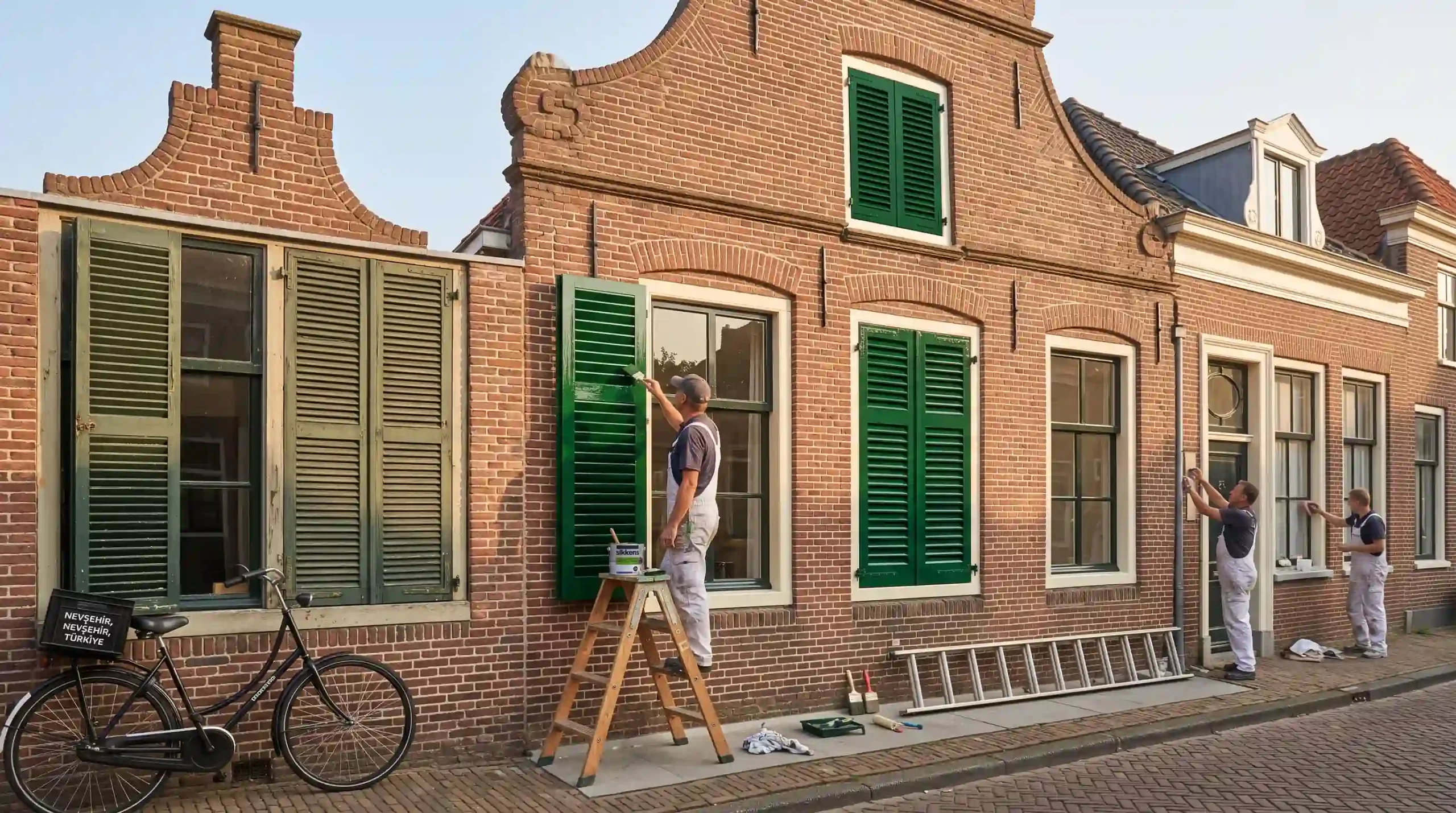
With proper maintenance, FSC-certified hardwood shutters will last 20 to 30 years. This maintenance mainly consists of a coat of paint or a stain treatment every four to six years, an annual inspection and regular cleaning. Anyone who neglects this will end up with irreparable wood rot. Those who keep up with the maintenance will have shutters that look as good as new for decades.
Why maintenance is essential for wooden shutters
Wood is a living material that reacts to moisture, heat and UV radiation. External shutters are exposed to all weather conditions: rain, frost, summer heat and direct sunlight. Without a protective coat of paint or stain, moisture penetrates the wood, causing cracks to form, and allowing mould and wood rot to take hold — particularly at the ends of the wood (the sides of planks and slats where the wood fibres are exposed).
Hardwoods such as Meranti, Merbau and Bankirai are naturally more resilient than softwoods. They naturally contain more oils and have a denser structure. That does not mean they do not require maintenance — it means that, with proper maintenance, they last considerably longer than softwood alternatives.
The protective layer of paint or stain acts as a barrier. As soon as that barrier cracks, flakes or wears away, moisture gains direct access to the wood. Damage always starts small — a small crack, a patch of peeling — but spreads quickly if left unchecked.
Painting or staining: which works better for hardwood?
For hardwood shutters such as Meranti, Bankirai and Merbau, there are two main options: opaque exterior paint or transparent/semi-opaque wood stain. The choice depends on the desired finish and the preferred maintenance regime.
Opaque exterior paint — Provides an even coat of colour and completely conceals the wood grain. Suitable for those who want a specific RAL colour. Adheres well to hardwood provided the correct primer is used. Drawback: if the surface is not properly prepared or if poor-quality paint is used, the top coat may blister or flake after a few years. A good-quality alkyd resin-based or water-based exterior varnish is the standard choice for hardwood used outdoors.
Transparent or semi-opaque wood stain — Leaves the wood grain visible and penetrates deeper into the wood than paint. It has poorer outdoor durability than a fully opaque paint system, but is easier to touch up: touch-ups can be carried out without having to sand the entire surface. Suitable for those who wish to preserve the natural appearance of the wood.
For new FSC-certified hardwood shutters, the general rule is: leave new hardwood untreated for six months to allow the natural oils in the wood to subside and make the surface more receptive to paint or stain. After that: degrease, sand, prime and finish.
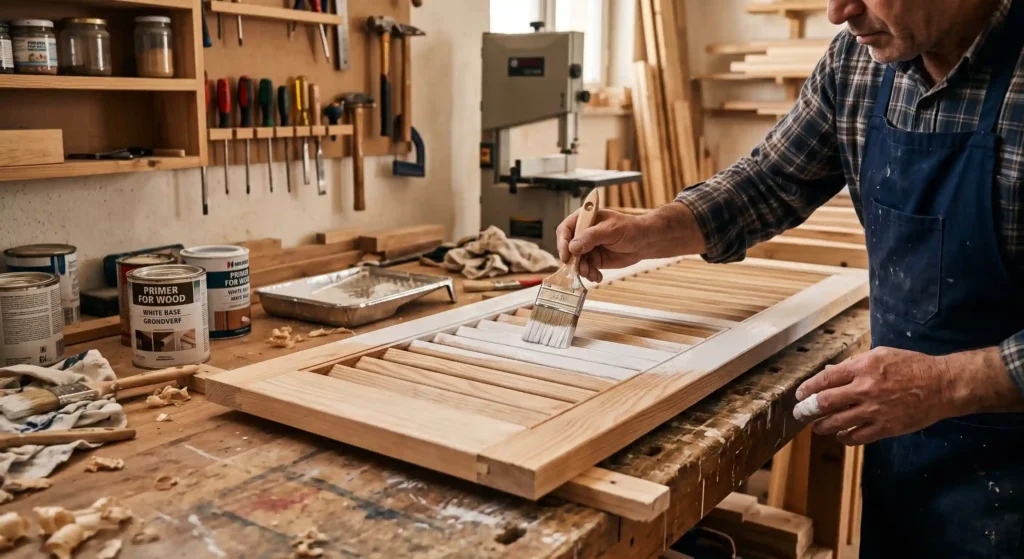
Step by step: maintaining wooden shutters
A complete maintenance cycle for existing hardwood shutters consists of six steps.
Step 1 — Cleaning Remove dirt, moss and cobwebs with a soft brush and mild soapy water. Is there any moss present? If so, use an environmentally friendly moss remover and allow the wood to dry completely before continuing — at least two dry days.
Step 2 — Inspection Check all edges, joints and the underside of the frame for cracks, peeling paint and signs of wood rot. Press a screwdriver into any suspicious areas: soft wood that gives way is rotten. Make a note of the affected areas for repair.
Step 3 — Sanding Sand the entire paint surface to a matt finish using 80–120-grit sandpaper to improve the adhesion of the new coat. Remove all flaking and loose paint completely. Pay particular attention to the edges. Dust off after sanding.
Step 4 — Repair: Fill small cracks and damage with a wood filler suitable for outdoor use. Allow to dry completely and sand smooth. Wood rot deeper than 5 mm: remove it and fill the area with epoxy wood filler, or have the part replaced.
Step 5 — Priming Apply an exterior primer suitable for hardwood. Please note: hardwood naturally contains oils which can reduce the adhesion of standard primers. Use an alkyd- or shellac-based primer for the best adhesion on Meranti and Bankirai.
Step 6 — Painting or staining Apply two coats of exterior paint or stain in the colour of your choice. Allow sufficient drying time between coats — at 20°C and normal humidity, the paint is usually ready for a second coat after 6 hours and fully cured after 2–3 days. It is best to work on a cloudy day or in the shade: direct sunlight dries the paint too quickly and results in an uneven finish.
How often should you maintain wooden shutters?
The maintenance cycle depends on three factors: the type of wood, its exposure to the sun and the quality of the previous paint finish.
| Situation | Recommended interval |
|---|---|
| FSC-certified hardwood (Meranti, Bankirai), good-quality paint, sheltered location | Every 6 years |
| FSC-certified hardwood, south-facing façade or full sun | Every 4–5 years |
| Hardwood with a clear stain | Every 3–4 years |
| Visible damage or detachment | Do it straight away — don’t put it off |
In addition to the full repainting cycle, an annual visual inspection is recommended. In early spring — after winter but before the painting season — check for frost damage, cracks and mould. Repairing minor damage straight away prevents moisture from seeping into the wood.
Hinges and fittings: the often-overlooked maintenance point
Shutter maintenance is not limited to the wood. The shutter fittings — thumb latches, hinges and fastenings — deserve just as much attention.
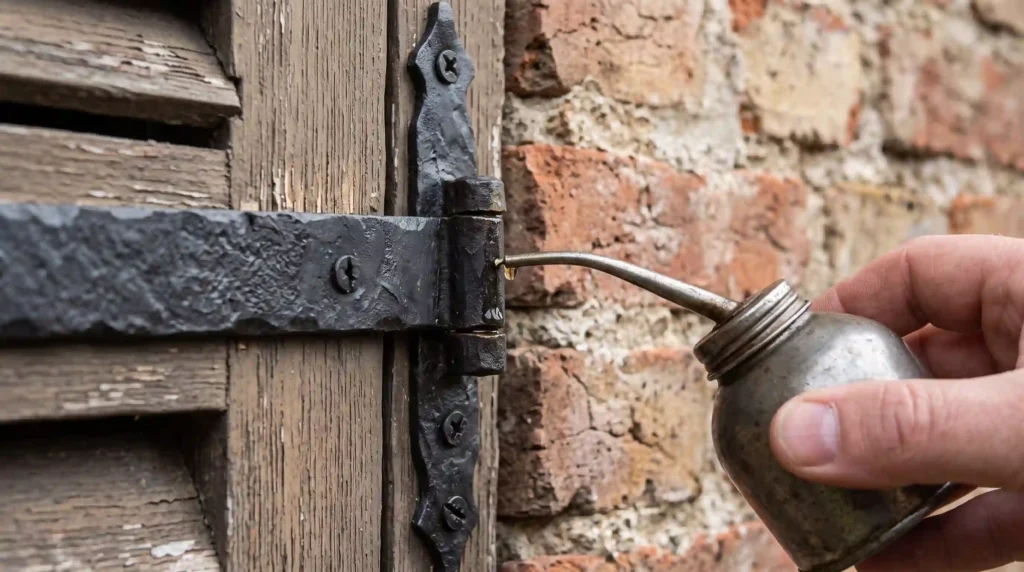
Lubricate the hinges (pivots and pins) twice a year with a drop of machine oil or silicone spray. Check that all screws are still tight — vibrations caused by the wind can gradually loosen them. Treat any rust on steel fittings with a rust converter; galvanised or stainless steel fittings do not have this problem.
Also check that the shutter locks and fastenings are working properly. A shutter that can be blown open by the wind will damage both itself and the window frame. Replace worn locks in good time.
When is a fresh coat of paint no longer enough?
There comes a point when maintenance is no longer sufficient and replacement is the better option. Signs that indicate a wooden shutter has reached the end of its service life:
- Wood rot affecting more than a quarter of the surface area — repairs are only temporary; the rot is spreading
- The shutter is hanging crookedly and can no longer be adjusted — the frame has warped due to years of fluctuating humidity
- The joints have come loose and the wood is no longer held together by glue or screws
- Several complete coats of paint have failed to adhere properly — the wood has become too dry or too porous
In all these cases, replacement is cheaper in the long run than repeated repairs. Shutters Inc. manufactures replacement wooden shutters entirely to measure, in the same style and colour as the existing shutters — ensuring the façade remains consistent.
Do you live in a listed building or a conservation area? If so, be sure to read our comprehensive guide to shutters for listed buildings: planning permission, historical detailing and exact reconstruction.
Frequently asked questions
How long do hardwood shutters last if properly maintained?
FSC-certified hardwood shutters made from Meranti, Bankirai or Merbau will last 20 to 30 years with regular maintenance. Their lifespan depends largely on exposure to sun and rain and the quality of the paint finishes.
Can I paint wooden shutters myself?
Yes, provided you use the correct primer for hardwood and carry out the preparation (cleaning, sanding, degreasing) carefully. Preparation accounts for 80 per cent of the final result. Do not skip the primer — without primer, the topcoat will not adhere properly to hardwood.
What colour paint can I use on wooden shutters?
All RAL colours are available in high-quality exterior paint. Dark colours absorb more heat and are more prone to cracking in intense sunlight — in which case, opt for a high-quality exterior paint that is UV-resistant. Shutters Inc. supplies new shutters as standard in your chosen RAL colour.
Do I need to take the shutters down before painting them?
For best results, yes. You can lay dismantled shutters flat, which prevents drips and makes it easier to access all sides (including the back and ends). In practice, shutters are also touched up on site — this works well for interim maintenance coats, but for a full renovation, dismantling is recommended.
What should I do if the wood has already started to rot?
Small areas of wood rot (less than 5 mm deep) can be treated with an epoxy wood filler: remove the rotten wood, treat with a hardener and fill with epoxy paste. Larger areas of rot or rot in load-bearing parts of the frame are a sign that the component or the entire shutter needs replacing.
How can I prevent mould and mildew from forming on my wooden shutters?
Green growth (algae and moss) forms in areas with little sunlight and high humidity. Regular cleaning with a mild soapy solution slows down growth. A good UV-resistant coat of paint that seals the wood significantly reduces the risk of green growth. Specific bio-based moss removers are effective against existing growth.
Do you have any questions about maintaining your wooden shutters, or would replacement be a better option? Ask Shutters Inc. for advice, with no obligation — we’ll usually get back to you within 24 hours. Request a quote
In brief — Wooden shutter maintenance | Shutters Inc.
- Maintenance cycle: paint or stain every 4–6 years, depending on the type of wood and location
- Hardwood (Meranti, Bankirai, Merbau): denser in texture, but does require a protective coat of paint
- Painting vs. staining: paint provides longer-lasting protection; stain is easier to touch up and preserves the wood grain
- Annual inspection: check the edges, joints and fittings in early spring
- Fittings maintenance: oil the hinges and thumbturns twice a year, check the screws
- Signs that replacement is needed: wood rot affecting more than a quarter of the cross-section, warped frame, loose joints
- Bespoke replacements: Shutters Inc. manufactures replacement shutters in the same style and colour at its own factory in Haaksbergen