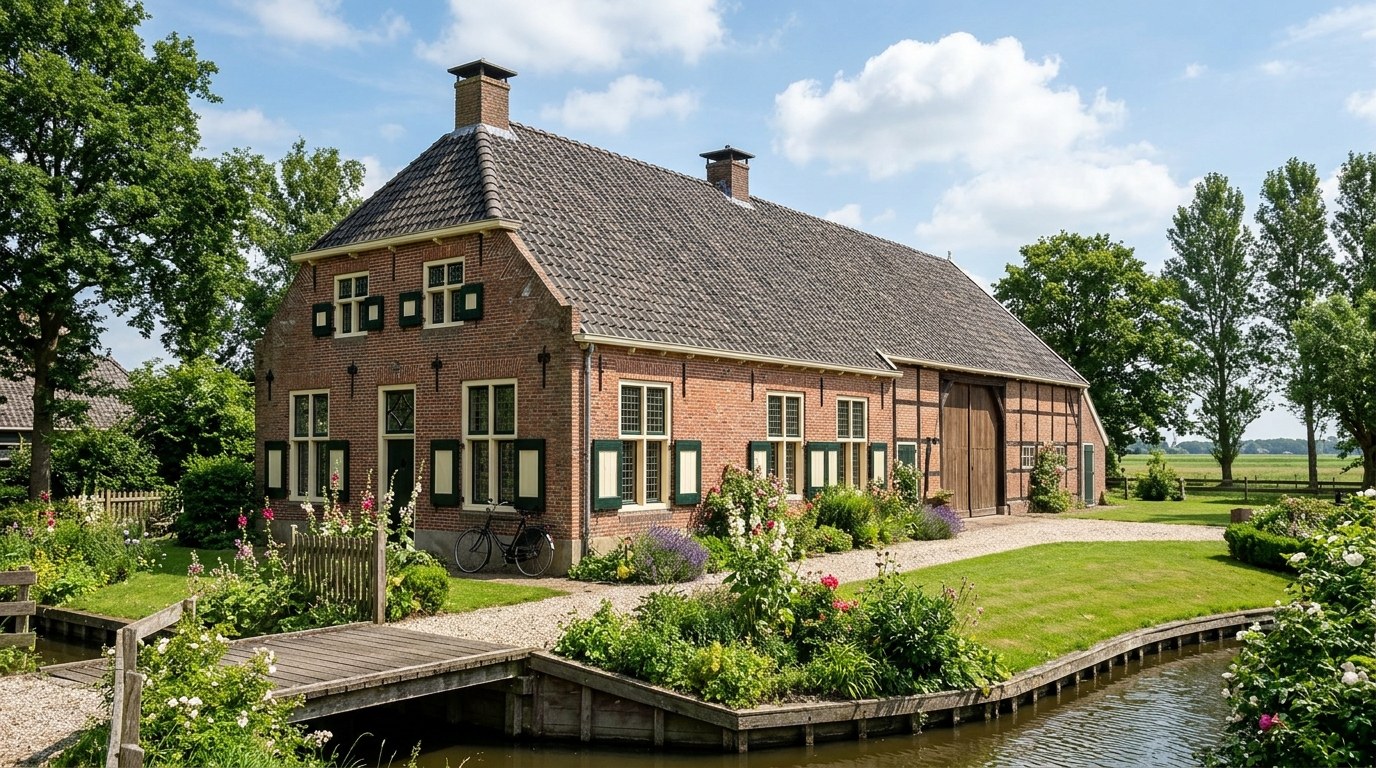
Clamped shutters are the most traditional and robust form of the Dutch exterior shutter. Whereas panel shutters and louvre shutters consist of a framed structure (stiles and rails) with infill, a clamped shutter comprises continuous vertical planks held together at the rear by horizontal cross-slats — known as ‘klampen’ — and a diagonal brace. This simple, traditional construction is not only suited to historic farmhouses, but is also increasingly being chosen for new rural builds, vicarages and modern barn-style homes. At Shutters Inc., we manufacture clamped shutters entirely to measure in both sustainable timber and maintenance-free aluminium.
What is the technical construction of a clamped shutter?
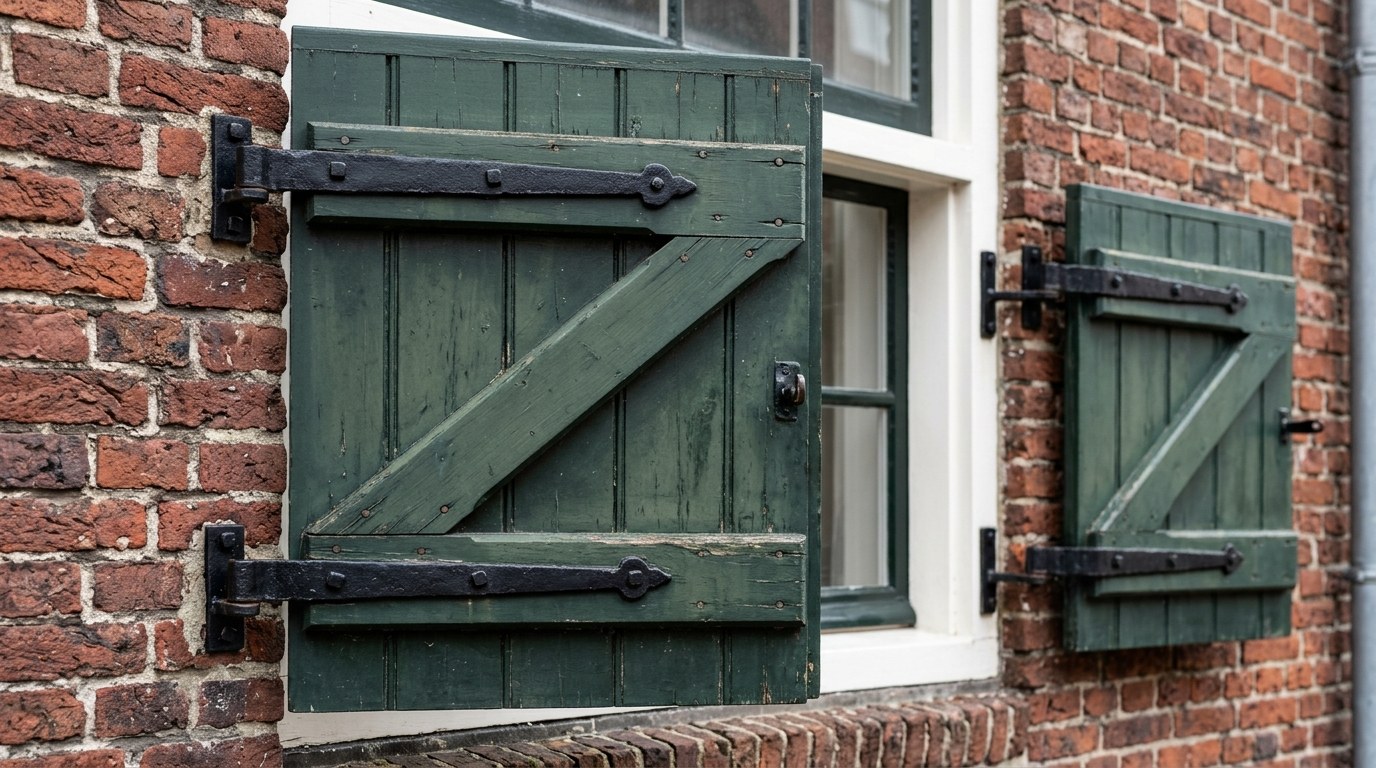
The strength of a clamped shutter lies in the simplicity of three components that together form a structurally stable whole:
- Vertical slats with tongue and groove: the shutter panel consists of vertical slats (often featuring a subtle bevelled edge or beaded profile) that interlock via a tongue-and-groove joint. For wooden shutters, we ensure minimal clearance in the groove, so that the wood can breathe as humidity levels fluctuate without gaps forming.
- Horizontal cross-braces: sturdy cross-braces are fitted to the vertical sections at the top and bottom (and, for tall shutters, also in the middle). These braces keep the shutter panel flat whilst also forming the sturdy base onto which the hinges are screwed.
- The diagonal brace (Z-bracing): between the bottom bracket and the top bracket, we fit a diagonal brace as required. From a structural point of view, the direction of this brace is essential: it must always run diagonally upwards from the lower hinge corner (near the thumb) towards the outer edge of the top bracket. This ensures the brace acts as a compression brace, preventing the shutter from ever sagging.
Clamped shutters or farmhouse shutters: what’s the difference?
In our showroom in Haaksbergen, we are regularly asked what exactly the difference is between clamped shutters and farmhouse shutters. Technically speaking, they are exactly the same construction consisting of vertical slats with clamps. The difference lies purely in the appearance and the paint finish:
- Plain clamped shutters: are spray-painted in a single solid colour — for example, classic heritage green (RAL 6009), canal green, anthracite (RAL 7016) or cream white — or finished in clear-varnished Red Cedar. This gives the shutter a calm and timeless appearance, which suits restored village houses, dyke cottages, barns and contemporary rural architecture perfectly.
- Traditional farmhouse shutters: these have the same clamped construction, but the flat panel is painted with a regional hourglass, diamond or mirror pattern (such as red and white in North Brabant, green and white with red piping in the Achterhoek and Twente, or yellow and red along the River IJssel). You can read more about these regional patterns in our article on the meaning and colours of hourglass shutters.
Which side can you see on the façade: the front or the back?
An important point to bear in mind when ordering clamped shutters is how the shutters are mounted on the wall. With a shutter that can be fully closed and rotates on pins and hinges, the clamps and brace are on the inside (the window side) when the shutter is closed. So, as soon as you open the shutters outwards against the external wall during the day, you’ll be looking directly at the sturdy side with the clamps, the brace and the long black hinges.
If, on the other hand, you opt for fixed decorative shutters (which do not need to be closed), you can decide for yourself which side is visible. Would you prefer the authentic look of an open shutter with visible clamps and hinges, or do you prefer the clean, vertical plank finish on the front? We make both options to measure in our workshop.
Wooden or aluminium clamped shutters: a fair comparison
Traditionally, clamped shutters are made of wood, but thanks to specially developed aluminium slat profiles, you can now also opt for a completely maintenance-free version. The overview below shows how the two designs compare:
| Features | Wooden clamped shutters (Meranti / Red Cedar) | Aluminium clipped hatches |
|---|---|---|
| Appearance | 100% authentic wood grain, bevelled edges and traditional joinery | Vertical grooved profiles with surface-mounted clamps and struts; very similar to wood |
| Weight & operation | Solid and heavy; natural movement accommodated by tongue-and-groove joints | Lightweight, completely dimensionally stable and never warps on south-facing walls |
| Maintenance | Repaint once every 6 to 8 years (depending on location and colour) | Virtually maintenance-free; simply wipe down with lukewarm water when cleaning the windows |
| Colour finishes | Multi-layer spray paint finish in any RAL or heritage colour, or transparent wood stain | Hard-wearing fine-textured or satin-finish powder coating in any RAL colour |
| Listed status | Suitable for listed buildings at national and local level | Ideal for new builds, renovations and homes not subject to listed building regulations |
Are you still unsure about which material to choose for your home? Then take a look at our comprehensive comparison of wooden, aluminium and UPVC shutters.
Wrought-iron shutter fittings complete the clamped shutter
Even more so than with panel or louvre shutters, the shutter fittings determine the appearance of a clamped shutter. The black hinges (with a semi-circular, pointed or lily-shaped head) run visibly over the horizontal clamps. Depending on how deep your window frame sits within the wall (the recess depth), we combine these hinges with mortise pins or plate pins of the correct shank size, so that the shutter turns neatly around the corner of the wall when opened. At the bottom, a classic shutter latch — such as the well-known ‘shepherdess’ latch or a heavy swivel with a stop — secures the shutter storm-proof against the masonry.
Do you live in a listed building or a conservation area? If so, be sure to read our comprehensive guide to shutters for listed buildings: planning permission, historical detailing and exact reconstruction.
Frequently asked questions
What is the difference between clamped shutters and farmhouse shutters?
Structurally, they are the same shutters: vertical sections (slats) connected at the rear by cross-braces and often a diagonal strut. In practice, we refer to them as farmhouse shutters when they feature a two-tone hourglass, mirror or diamond pattern, and as clamped shutters when they are finished in a single solid colour (such as heritage green, canal green or anthracite).
Why do clamped shutters have a sloping brace?
The diagonal brace (Z-brace) runs diagonally upwards from the lower corner of the slat to the outer edge of the upper brace. This brace supports the weight of the vertical slats under load and prevents the shutter from sagging or becoming crooked over the years.
Are clamped shutters also available in maintenance-free aluminium?
Yes. As well as traditional Meranti or Red Cedar, we supply aluminium clamped shutters with vertical grooved profiles, surface-mounted clamps and struts. With a textured powder coating and traditional shutter fittings, they are virtually indistinguishable from painted wood from a distance of a few metres, yet you’ll never have to paint them again.
Which side of a clamped shutter is visible when the shutter is open?
With a functional hinged shutter that pivots on pins and hinges, the shutter swings open 180 degrees against the façade. As a result, when the shutters are open, you will see the side with the cross-braces and the strut. With decorative shutters (which are screwed securely to the wall), you can choose whether the flat plank side or the clamped side faces outwards.
Which shutter fittings are suitable for clamped shutters?
Clamped shutters are traditionally hung using straight or offset-hinges that run exactly over the top and bottom rails, combined with plate pins or mortised pins in the masonry and classic shutter winders (such as the ‘shepherdess’ or a winder) to keep the shutters open.
How can you prevent wooden clamped shutters from warping?
We use quarter-sawn, kiln-dried hardwood (such as Meranti) with tongue-and--groove joints that can accommodate minor shrinkage and expansion; we glue and screw the clamps in a tension-free manner and apply a multi-layer paint system to the all-round surface of each shutter in our own paint shop in Haaksbergen.
Would you like to have bespoke wooden or aluminium clamped shutters made for your farmhouse or country home? Request advice and a quote with no obligation — we’ll usually get back to you within 24 hours. Request a quote
In brief — Clamped shutters | Shutters Inc.
- Construction: vertical tongue-and-groove slats, joined by horizontal cross-braces and an optional diagonal Z-brace
- Design: available in a single subtle, plain RAL or heritage colour, or as a traditional farmhouse shutter with an hourglass design
- Materials: handcrafted from durable hardwood (wooden clamped shutters) or maintenance-free powder-coated aluminium
- Fittings: complete with black-coated stainless steel or wrought-iron hinges, thumb turn handles and shutter pivots
- Shutters Inc.: measured on site, manufactured in our own factory in Haaksbergen and professionally fitted throughout the Netherlands