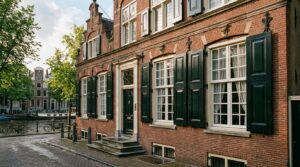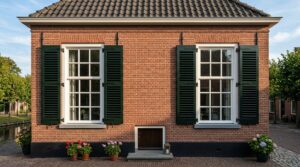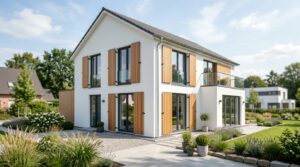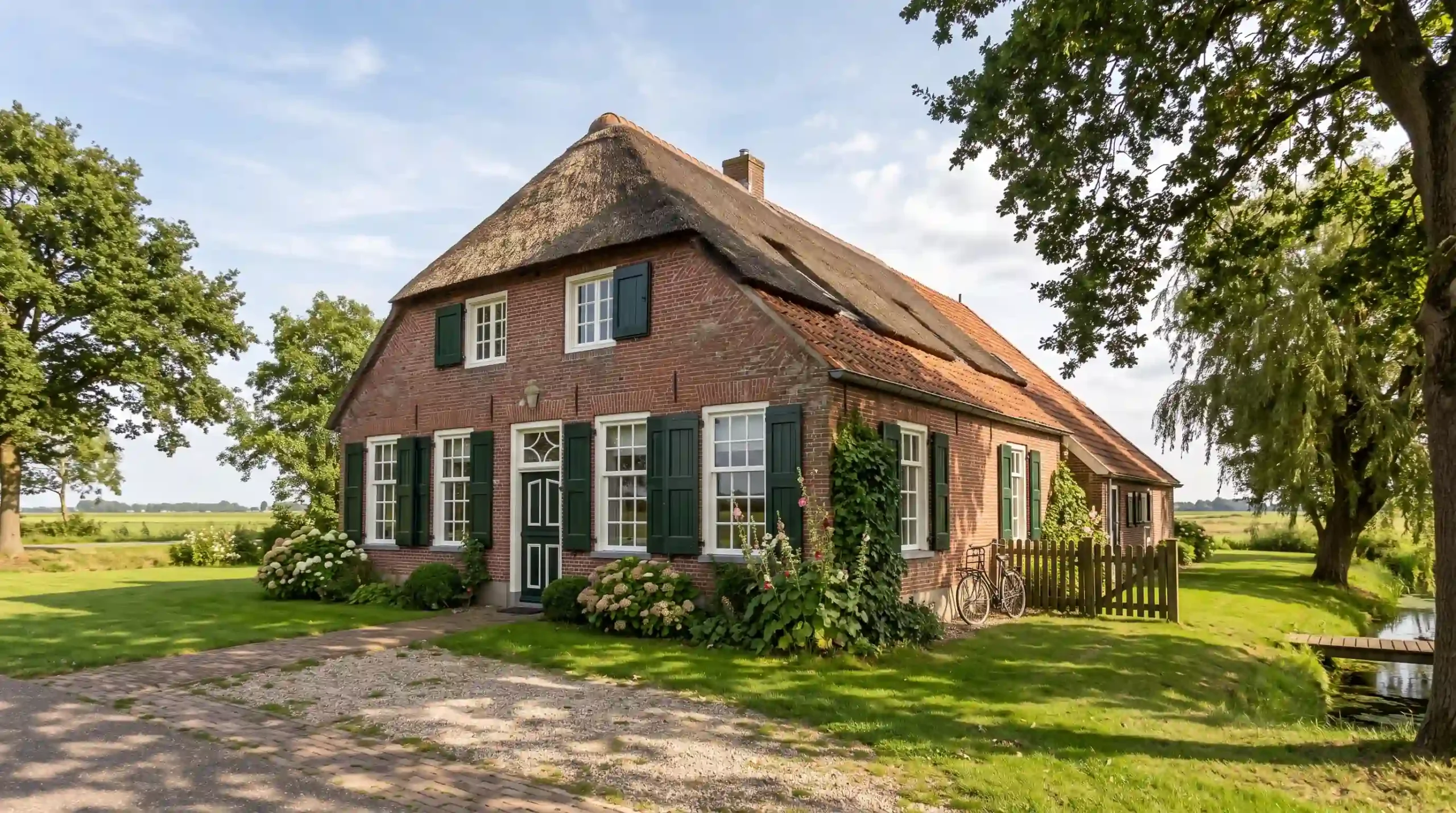
Farmhouse shutters — expertly clamped shutters — are the most recognisable style of shutter in the Dutch countryside. They consist of vertical planks joined together by horizontal and diagonal clamping beams. The hourglass or ‘diabolo’ motif on the clamping beams is a centuries-old Dutch tradition that varied in shape and colour from region to region. Anyone wishing to fit shutters to a farmhouse, country home or listed building almost always opts for this type.
Farmhouse shutters and clamped shutters: what is the difference?
Neither — the two terms describe the same type of shutter. ‘Farmhouse shutter’ is the colloquial term; ‘clamped shutter’ is the technical term referring to the method of construction: vertical planks that are ‘clamped’ — secured — with horizontal cross-bars at the rear.
Other names you may come across include: farmhouse shutters, farmhouse shutters and barn shutters. They all refer to the same traditional type of shutter that has been used for centuries on Dutch farms, barns and country houses.
The construction of a clamped shutter
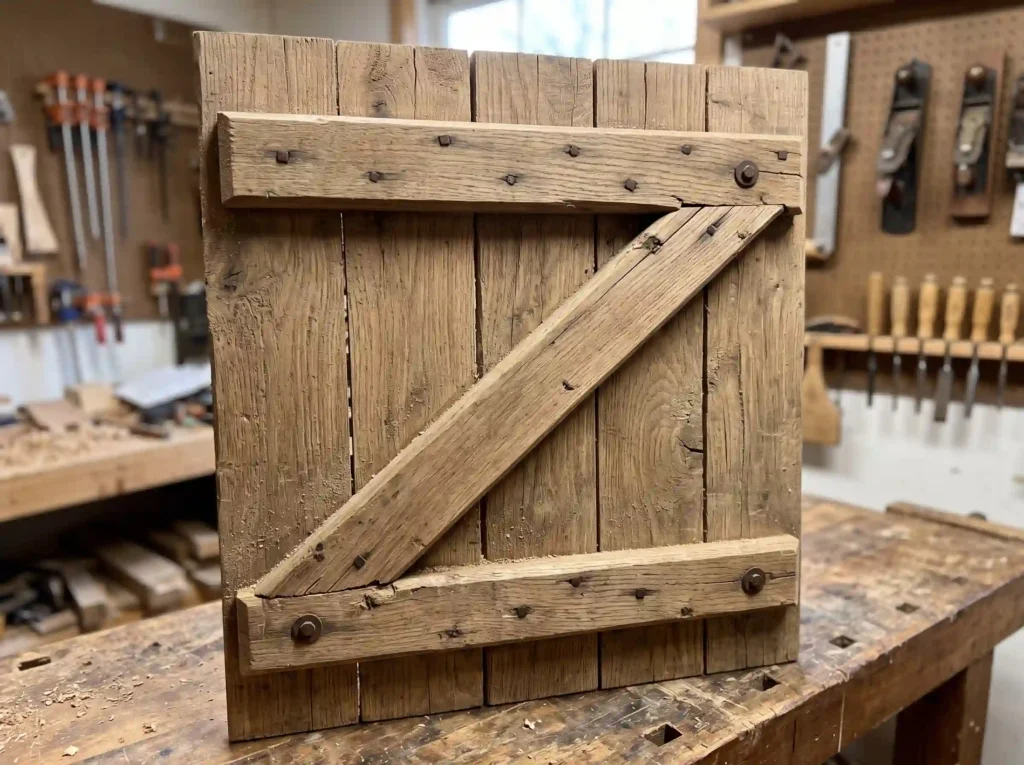
A clamped shutter consists of three structural elements:
Vertical planks form the visible surface of the shutter. They are placed side by side, either with or without a small gap between them (open or closed joint). The width of the planks varies depending on the style — narrower planks give a more delicate appearance, whilst wider planks lend a more robust character.
Clamping beams are the horizontal cross-beams at the rear that hold the vertical planks together and prevent warping. A standard clamped shutter has two clamping beams — one at the top and one at the bottom. For larger shutters, a third clamping beam is added in the middle for extra stability.
A Z-brace, or diagonal brace, is the diagonal beam that runs between the clamping beams. The Z-brace prevents the shutter from warping under the weight of the planks. It is also the element that gives the rear of a farmhouse shutter its characteristic Z- or N-shape — and forms the basis for the decorative hourglass motif on the front.
For hardwood farmhouse shutters, Shutters Inc. uses FSC-certified Meranti or Bankirai — both of which are stable, durable and resistant to changing weather conditions. Oak and red cedar are also available on request.
The hourglass and diabolo motifs: a Dutch tradition
The hourglass motif — also known as a diabolo or hourglass ornament — is the most characteristic decorative element of the traditional Dutch farmhouse shutter. It consists of two triangular or curved shapes adjoining one another, creating the silhouette of an hourglass. The motif is applied to the clamping beams on the front of the shutter, or carved directly into the wood itself.
The origin of the motif varies by region. In Twente and the Achterhoek, the hourglass motif often had a symbolic protective meaning — similar to other folk ornamentation found on farmhouses. The colours used to paint the motif varied by region: red and white were common in the east of the country; green and white in other parts. Some farms combined the motif with the colour associated with the estate or farm.
Shutters on farmhouses primarily served a protective function — they shielded the living quarters from wind, cold and excessive sunlight. Made by the local carpenter, their shape and design were often specific to the region, whilst the use of colour and ornamentation was employed to indicate the farmhouse’s affiliation.
Shutters Inc. manufactures bespoke farmhouse shutters with an hourglass motif — the motif can be cut into the clamping beam or fitted as an applied ornament, depending on the desired look and the character of the property.
Regional styles: Achterhoek, Twente and Brabant
The farmhouse shutter is not a uniform product — the style varied by region and by period of construction. Some characteristic regional variations:
Achterhoek and Twente — The classic farmhouse shutters of the Achterhoek and Twente regions feature wide planks, a robust construction and are traditionally painted in pine green (RAL 6009) or dark blue. The red-and-white hourglass pattern has traditionally been the most common here. Farmhouses in this region often have wide window openings with heavy shutters — the dimensions therefore require additional clamping beams and heavy-duty fittings.
Brabant and Zeeland — In Brabant, farmhouse shutters have slightly narrower planks and are more often painted in wine red or warm white. The hourglass motif is less prominent here than in the east; the clamping beam has a simpler rectangular shape.
North Holland and Friesland — Wooden farmhouse shutters are less common in the countryside here than in Gelderland and Overijssel, but can be found on characteristic thatched farmhouses. Blue and green are the traditional colours.
Limburg — Farmhouse shutters in Limburg show the influence of Belgian and German traditions: they have a slightly more Mediterranean character, with narrower planks and a more refined construction. Shutters Inc. has completed several projects in Limburg, including the restoration of shutters on a historic half-timbered farmhouse in Siebengewald.
Functional or decorative: which suits your farmhouse best?
Farmhouse shutters can be designed to be both functional (opening and closing) and decorative (fixed in place). The choice depends on the window opening, the desired level of security and everyday use.
Functional farm shutters are hung on hinges with pins and hangers, and can be closed completely in front of the window. They offer protection against wind and rain, reduce sunlight and improve burglary resistance when the shutters are closed. Functional farmhouse shutters are heavier than louvre or panel shutters of a similar size — heavy-duty fittings in stainless steel or galvanised wrought iron are required.
Decorative farmhouse shutters are fitted securely next to the window using mounting strips or brackets. They give the façade the character of a farmhouse without the shutters needing to open or close. The decorative version is easier to install and cheaper — the dimensions do not need to cover the window opening exactly.
For traditional farmhouses and listed buildings, the functional option is the more authentic choice. For modern renovations aiming to recreate a farmhouse atmosphere, the decorative option is often sufficient.
Farmhouse shutters on listed buildings and characteristic properties
Listed farmhouses and buildings with architectural designation impose specific requirements on shutters. In many cases, the local authority or the Cultural Heritage Agency of the Netherlands (RCE) stipulates that façade elements must be restored or replaced in the original style, using the original materials and the original colour.
The following generally applies to farmhouse shutters on listed buildings:
- Material: wood — aluminium and upvc are rarely permitted on listed farmhouses
- Style: the original shutter style (clamped, hourglass motif) must be retained
- Colour: the historically accurate colour for the region — consult the planning committee
- Bespoke: made to fit the existing window frames exactly — standard shutters rarely fit historic window openings
Shutters Inc. has experience in producing bespoke shutters for listed buildings and, on request, works in collaboration with the local council and the property owner to produce shutters that comply with planning regulations. Please contact us for advice on projects involving listed buildings.
For heritage projects, it is advisable to consult the Cultural Heritage Agency of the Netherlands regarding the specific requirements for your property.
Do you live in a listed building or a conservation area? If so, be sure to read our comprehensive guide to shutters for listed buildings: planning permission, historical detailing and exact reconstruction.
Frequently asked questions
What is the difference between a farmhouse shutter and a panelled shutter?
A farmhouse shutter consists of vertical planks with clamping beams at the rear — the construction is visible from the front via the clamping beam. A panel shutter has a smooth, solid panel set within a frame — the construction is not visible from the front. Farmhouse shutters have a more robust, traditional character; panel shutters are sleeker and more timeless.
Are farmhouse shutters also available in aluminium?
Yes. Shutters Inc. supplies aluminium clamped shutters — the same traditional design but in low-maintenance, powder-coated aluminium. For listed buildings and authentic farmhouses, wood is the most suitable choice; for renovation projects where maintenance is a consideration, aluminium is a good alternative.
Can I have the hourglass motif omitted?
Yes. The hourglass pattern is a decorative option — farmhouse shutters are also available without a pattern, featuring a sleek rectangular clamping beam. The basic construction (vertical planks + clamping beams + Z-brace) remains the same.
How heavy are wooden farmhouse shutters?
The weight depends on the dimensions and the type of wood. A hardwood farmhouse shutter measuring 60 × 120 cm made of Meranti typically weighs between 8 and 14 kg per panel. With larger dimensions, the weight increases rapidly — this requires heavy-duty fittings and sturdy handles, preferably made of stainless steel or wrought iron.
Are farmhouse shutters also suitable for modern homes?
Yes, provided the architecture allows for it. Farmhouse shutters in a modern colour (anthracite, dark grey) on a contemporary home create a ‘farmhouse chic’ effect that is currently popular in farmhouse homes and country estates. The robust construction deliberately contrasts with modern materials such as stucco or Corten steel.
How much maintenance do wooden farmhouse shutters require?
The same maintenance routine as for all hardwood shutters: paint or stain every four to six years, and carry out an annual inspection for cracks and loose panels. See our maintenance guide for wooden shutters for a full step-by-step plan.
Are you looking for bespoke farmhouse shutters for your home, farmhouse or listed building? Request a no-obligation quote — you’ll usually hear from us within 24 hours. Request a quote
In brief — Farmhouse shutters | Shutters Inc.
- Definition: farmhouse shutter = clamped shutter — vertical planks + clamping beams + Z-brace
- Hourglass motif: a traditional decorative ornament on the clamping beam, with a regional colour scheme (red and white in the east of the Netherlands)
- Wood types: FSC-certified hardwood (Meranti, Bankirai), oak or red cedar on request
- Regional styles: Achterhoek/Twente → pine green, wide planks; Brabant → wine red, slimmer
- Functional or decorative: functional with hinges for authentic operation; decorative with strips for easy fitting
- Listed building: always timber, original style and colour — consult the local authority/RCE
- Aluminium version: also available as a low-maintenance alternative
- In-house factory: Shutters Inc. Haaksbergen — bespoke solutions for every window opening