Houses with shutters instantly gain more character, but only if the type, material and colour of the shutters match the architectural style. A 1930s house calls for panel or louvre shutters, a farmhouse for clamped shutters, a townhouse for tall louvre shutters and a modern home for sleek sliding or slatted shutters. Precise measurements and a single, consistent colour across each façade complete the look.
Why shutters add so much character to a house
Shutters give a house character because they frame the windows, create rhythm in the façade and add colour precisely where the eye is drawn. A façade without shutters looks like brickwork with holes; with shutters, the windows become a deliberately designed part of the whole.
That explains why houses with shutters feature so often in inspiration collections. However, not every type of shutter suits every house. A heavy, hinged farmhouse shutter on a sleek terraced house looks out of place, and a minimalist aluminium sliding shutter on a solicitor’s house feels out of context. The architectural style determines which shutter looks authentic.
| House style | The right type of shutter | Material | Colour tip |
|---|---|---|---|
| 1930s house | Panel or louvre shutters | Wood | Dark green, oxblood red, off-white |
| Farmhouse, farmhouse residence | Hinged shutters, hourglass pattern | Wood | Green and white, red and white, yellow and green |
| Mansion, villa | Tall louvre shutters | Wood | Anthracite, dark green, black |
| Terraced house, through-house | Panel shutters, often decorative | UPVC or aluminium | Designed to match your window frames |
| Rural detached house | Flat, clamped shutters or combination shutters | Wood | Dark green, grey-green, anthracite |
| Modern home, barn-style home | Sliding shutters, louvres | Aluminium or wood | Anthracite, black, natural wood |
| Listed building | Original style, faithfully reproduced | Wood | Historical colour schemes, by arrangement |
A 1930s house with shutters
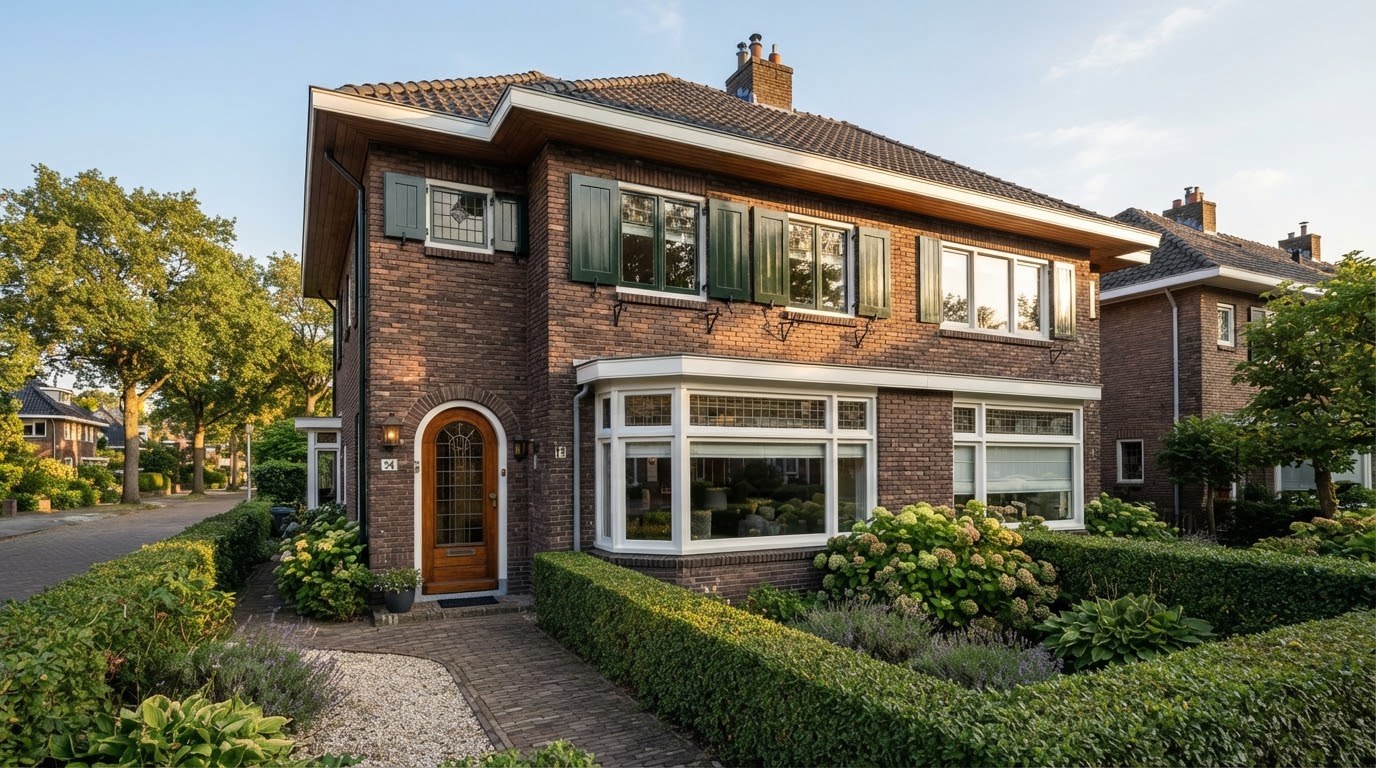
A 1930s house is a home from the interwar period, characterised by dark brickwork, bay windows, stained-glass skylights and, often, a roof with a substantial overhang. Shutters were common on these houses and still complement them perfectly.
For this style, opt for wooden panel shutters or louvre shutters on the upper-storey windows or next to narrow, tall windows. A bay window is not usually fitted with shutters: the shape of the bay window itself is the focal point. Classic colours include dark green, oxblood red and off-white, often combined with white window frames. In our article on choosing shutter colours, you can read how to coordinate your window frames, shutters and brickwork.
Farmhouses and farm-houses
A farmhouse with shutters is the most recognisable image of shutters in the Netherlands. Shutters held open — planks held together by crossbars and a brace — are a feature of farmyards, often painted with a two-colour hourglass motif.
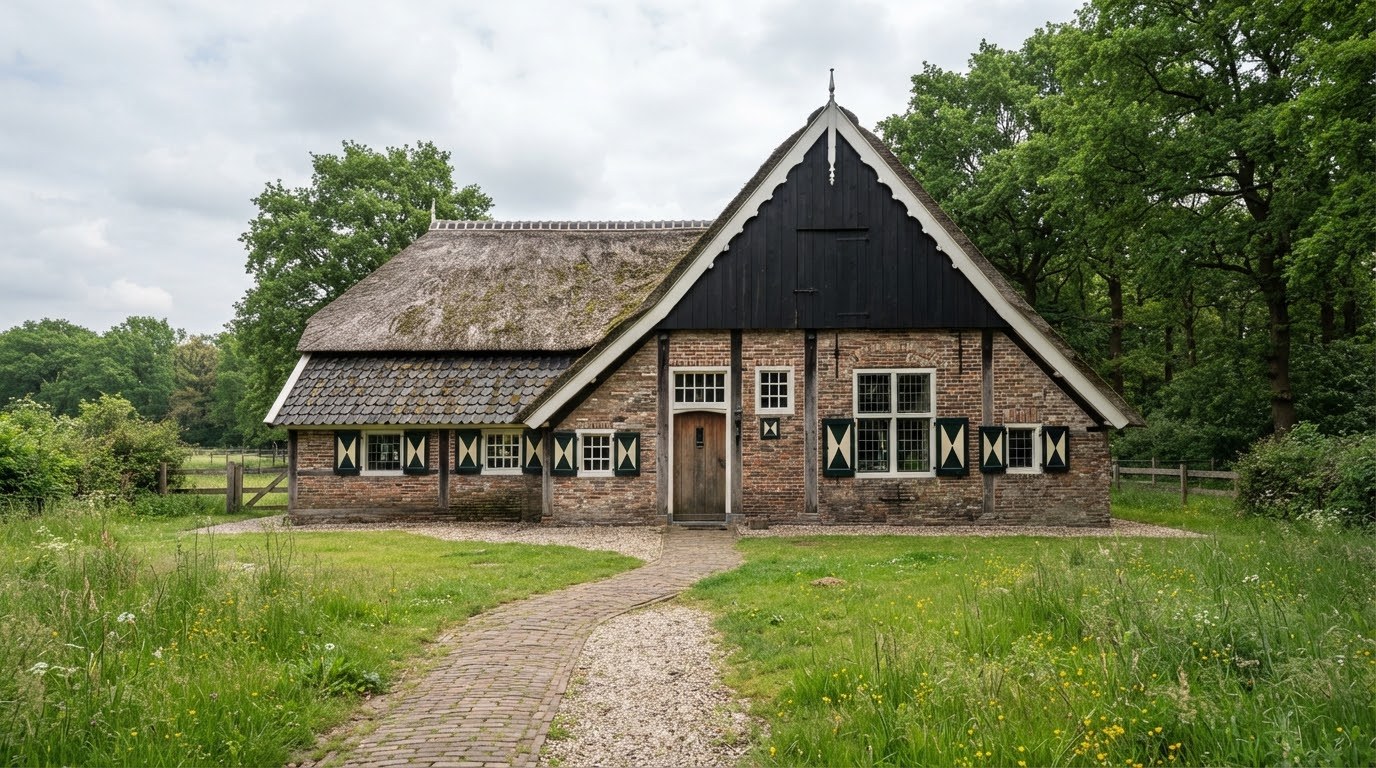
The hourglass or ‘diabolo’ pattern varies by region: green and white is widespread, whilst red and white and yellow and green are traditional in some areas. For a farmhouse, you can follow tradition to the letter or give it a more modern twist with plain shutters in a single dark colour. You can read all about types, patterns and colours in our guide to farmhouse shutters.
Mansion, villa and notary’s house
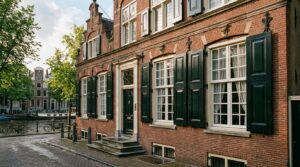
A townhouse or notary’s house is a stately, often symmetrical house with tall windows and a distinct central feature around the front door. Tall, slender shutters are ideal here, as they emphasise the vertical lines of the windows.
Louvre shutters — with slats set at an angle — are the classic choice for this style: they look light and refined, and still let in some light and air when closed. You can read more about this type on our page about louvre shutters. Choose a dark, understated colour such as anthracite, dark green or black, and keep all the shutters on the front façade the same. Symmetry is everything with these houses.
Terraced houses and through-lit homes
A terraced house or a house with windows running the full width of the front usually has wide windows and little space alongside the window frames. Nevertheless, shutters can work here too, particularly to give a uniform street frontage its own distinctive character.
In these homes, shutters are often used for decorative purposes: they are fixed next to the window and do not close. This saves on fittings and costs, but the shutter must still have the correct proportions, otherwise it will look like a loose panel. Low-maintenance upvc or aluminium shutters are popular here: they stay looking smart for years without needing a coat of paint, which is handy if you don’t want to put up scaffolding on a row of terraced houses.
Rural detached house
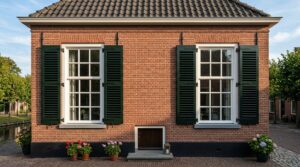
A rural detached house is a newer or converted property in a rural style, with features reminiscent of a farmhouse or an English cottage but without an agricultural history. Think of a house with a thatched or tiled roof, white-painted or dark cladding, and window frames with glazing bars.
This style offers you the greatest freedom. Clamped shutters in a single solid colour are a understated alternative to farmhouse shutters. Combination shutters — with a solid panel at the bottom and slats at the top — combine privacy with light and air, and are well suited to ground-floor bedrooms. Choose wood if you’re looking for a traditional look, and select a colour that complements the roof tiles or thatch: dark green, grey-green and anthracite almost always work well here.
If you really want to use the shutters for sun protection or privacy, choose functional shutters that close properly, with handles and hinges designed to support the weight of the shutter.
Modern homes and barn-style homes
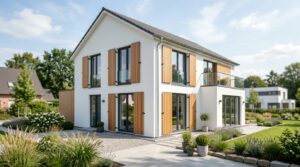
A modern house or barn-style home combines simple shapes with large glass surfaces and often features a wooden or dark façade. Traditional hinged shutters are less suited to this style; sliding shutters and louvres complement the clean lines better.
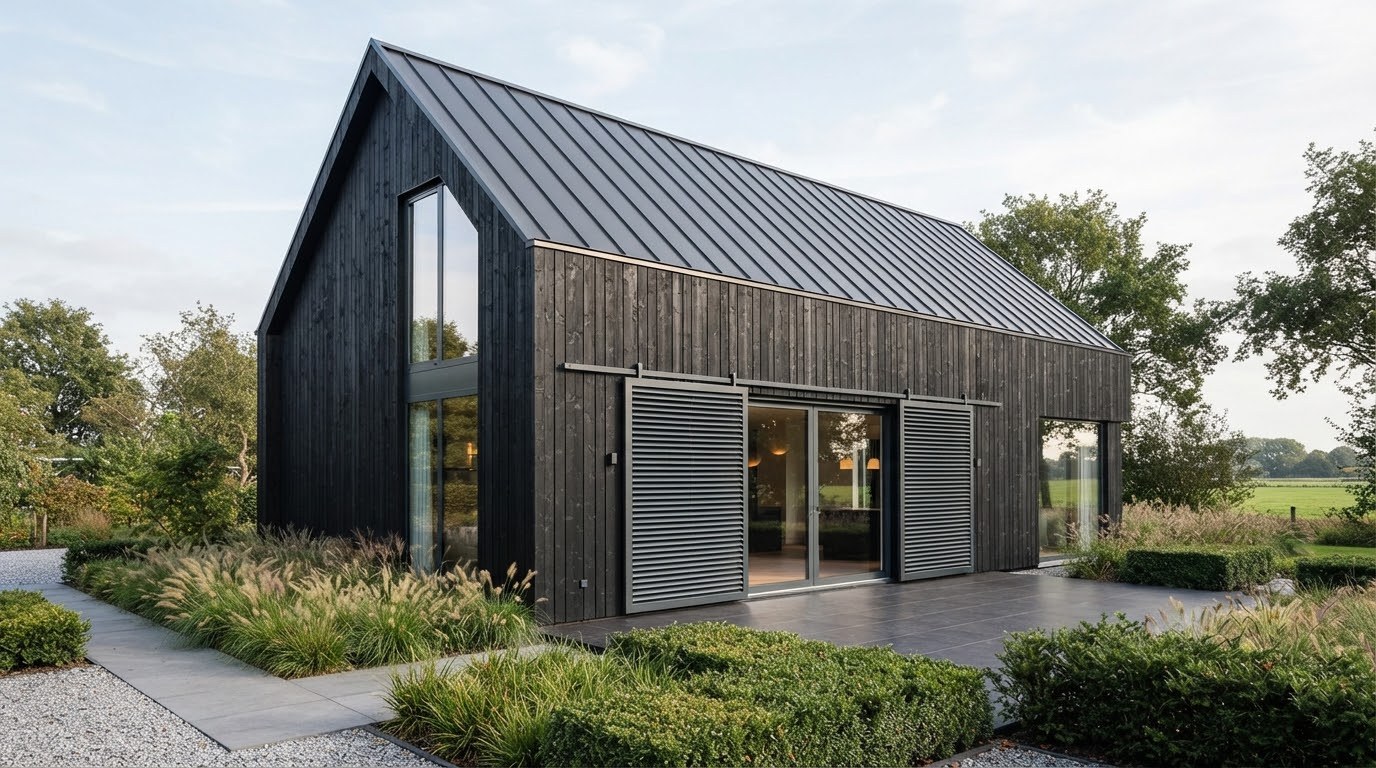
Sliding shutters run along a rail on the façade and can be slid across a wide frontage or a window without having to swing open against the wall. This is ideal for large glazed areas facing south or west, where sun protection is also a practical necessity. Aluminium shutters in anthracite or black complement a black-stained façade; wooden sliding shutters in a natural shade create a warmer, rustic-modern look.
Listed buildings and conservation areas
A listed building with shutters requires shutters that remain as close as possible to the original: the same type, the same dimensions and historically appropriate colours. Often, there is still an original shutter or an old photograph to work from.
If your property is a listed building at national or local level, you will need a planning permission for virtually any alteration. According to monumenten.nl, this applies not only to major renovations, but even to a simple paint job. If you live in a protected town or village conservation area, additional rules may also apply to the front façade. You should therefore consult your local council before having shutters made or choosing a new colour.
Five design rules for houses with shutters
Houses with shutters look their best when the shutters appear as though they can actually be closed, even if they are purely decorative. These five design rules will help you achieve this:
- Width: each shutter is half the width of the window, so that two closed shutters cover the window exactly. Shutters that are too narrow immediately give away the fact that they are merely decorative.
- Height: the shutter is the same height as the window opening, from the bottom sill to the top lintel.
- One type per façade: do not mix different types of shutters on the same side of the façade. In the case of a farmhouse, the front and side façades may differ.
- One colour per façade: choose a single shutter colour and stick to it consistently, perhaps with a second colour for the pattern.
- Visible fittings: genuine thumb turn handles, hinges and fasteners give the shutter an authentic look. A shutter fixed to the wall with invisible screws looks flat.
Are you unsure about sizes or types? Shutters Inc. will measure your windows on site to ensure the shutters fit your windows and architectural style perfectly. You can see examples of completed homes in our projects section.
Frequently asked questions
Which shutters suit my house?
That depends on the architectural style. Panel and louvre shutters suit 1930s homes, clamped shutters suit farmhouses, tall louvre shutters suit townhouses, and sliding shutters or slatted shutters suit modern homes. Terraced houses often have low-maintenance decorative shutters.
How wide should shutters be?
Ideally, each shutter should be half the width of the window, so that two closed shutters cover the opening exactly. The height should be the same as the window opening. This proportion also ensures a natural-looking appearance with decorative shutters.
Do shutters suit a modern house?
Yes, but in that case, opt for clean, simple designs: sliding shutters, aluminium louvre shutters or plain panel shutters in a dark colour. Classic clamped shutters or shutters with a pattern are less suited to modern architecture.
Can I fit shutters to a listed building?
If your property is a listed building (either at national or local level), you will need planning permission for virtually any alteration, including fitting shutters or repainting. Always consult your local council first.
Can shutters be fitted to an existing house as a retrofit?
Yes, shutters are made to measure for existing windows and are fixed to the façade or window frame using brackets. It is important that there is enough wall space next to the window to allow the shutters to rest open against the façade.
Which colour of shutters looks best?
Dark green, anthracite, black and off-white are timeless choices. The best colour depends on the brickwork, the colour of the window frames and the architectural style; for farmhouses, regional traditions also play a part.
Looking for shutters to match your home? Request some no-obligation advice and a quote — we’ll usually get back to you within 24 hours. Request a quote
In brief — Houses with shutters | Shutters Inc.
- 1930s house: wooden panel or louvre shutters, dark green or oxblood red
- Farmhouse: shutters with clamps, often featuring an hourglass pattern in regional colours
- Mansion and villa: tall louvre shutters, understated dark colour, symmetrical
- Terraced houses: low-maintenance upvc or aluminium shutters, often decorative
- Country-style home: plain, clamped shutters or combination shutters in wood
- Modern homes: sliding shutters or slatted shutters in aluminium or wood
- Listed buildings: replicating the original design; planning permission is almost always required
- Design guidelines: shutters should be half the width of the window, the full height of the window, and there should be one type and one colour per façade
- Shutters Inc.: bespoke wooden, aluminium and UPVC shutters, measured on site — our own factory in Haaksbergen