Larch timber is a resinous softwood native to Europe and Siberia with a warm, orange-brown colour. It falls into durability classes 3 to 4, is relatively dense for a softwood and can be used outdoors untreated, after which it weathers to a silvery-grey colour. Larch is particularly strong when used as cladding; for shutters and window frames, dimensionally stable hardwood is the safer choice.
What is larch timber?
Larch timber is the wood of the larch (genus Larix), one of the few conifers that shed their needles in winter. Two species are mainly found on the market: European larch (Larix decidua) from the Alps and Central Europe, and Siberian larch (Larix sibirica) from Russia and Scandinavia.
The heartwood is yellow-brown to reddish-brown, whilst the sapwood is pale yellow and clearly distinguishable. Larch contains a high resin content. This resin provides the wood with natural protection against moisture, but also causes certain peculiarities when working with and painting the wood, which we shall return to later.
It is characterised by its distinct annual rings and knots. This gives larch a lively, natural character that suits both rustic and modern architecture.
| Properties | Larch timber |
|---|---|
| Botanical name | Larix decidua (European), Larix sibirica (Siberian) |
| Durability class | 3–4 (heartwood is more durable than sapwood) |
| Density (12% moisture content) | approx. 470–590 kg/m³ European, up to approx. 650 kg/m³ Siberian |
| Colour | Yellow-brown to reddish-brown heartwood, pale yellow sapwood |
| Behaviour | Moderate — heartwood fairly stable, sapwood more prone to warping |
| Distinctive feature | Contains resin; when left untreated, it weathers to a silvery-grey colour |
European, Siberian or Dutch larch
European, Siberian and Dutch larch belong to the same family of trees, but differ in their growing conditions and, consequently, in their density and appearance.
Siberian larch grows slowly in a cold climate, producing narrow annual rings. As a result, the wood is denser (up to approximately 650 kg/m³) and often has a somewhat more uniform grain. It is widely available as planed or finely sawn cladding.
European larch is slightly lighter in colour and often has wider annual rings and more knots. It is easy to work with and is used for cladding, fences, pergolas and revetments.
Dutch larch is European larch that has grown in the Netherlands. Staatsbosbeheer supplies finger-jointed larch cladding from FSC-certified Dutch forests. Removing the sapwood and finger-jointing the pieces results in a more stable, straighter and dimensionally more consistent product — with the added bonus of a short transport distance.
How durable is larch timber when used outdoors?
The durability of larch timber is moderate: according to the European classification (EN 350), it falls into classes 3 to 4, depending on its origin and the ratio of heartwood to sapwood. By way of comparison: spruce and pine are in class 4, whilst tropical hardwoods such as Merbau are in class 1–2.
In practice, Class 3 means that, when used above ground and well ventilated, untreated larch will last for around 10 to 15 years. With good detailing — no standing water, ventilation behind the timbers, end grains protected — this lifespan may be longer. Larch is not suitable for use in contact with the ground.
Two factors determine whether larch will last a long time outdoors:
- Heartwood versus sapwood: sapwood is more susceptible to mould and is more prone to warping. For cladding, it is best to choose sapwood-free larch.
- Detailing: timber that dries quickly will last a long time. A ventilated cavity behind the cladding is therefore more important than the type of timber itself.
Would you like to see all the durability classes and timber types side by side? In our guide to timber for outdoor use, we compare larch with hardwood, Douglas fir and modified timber.
Larch as cladding
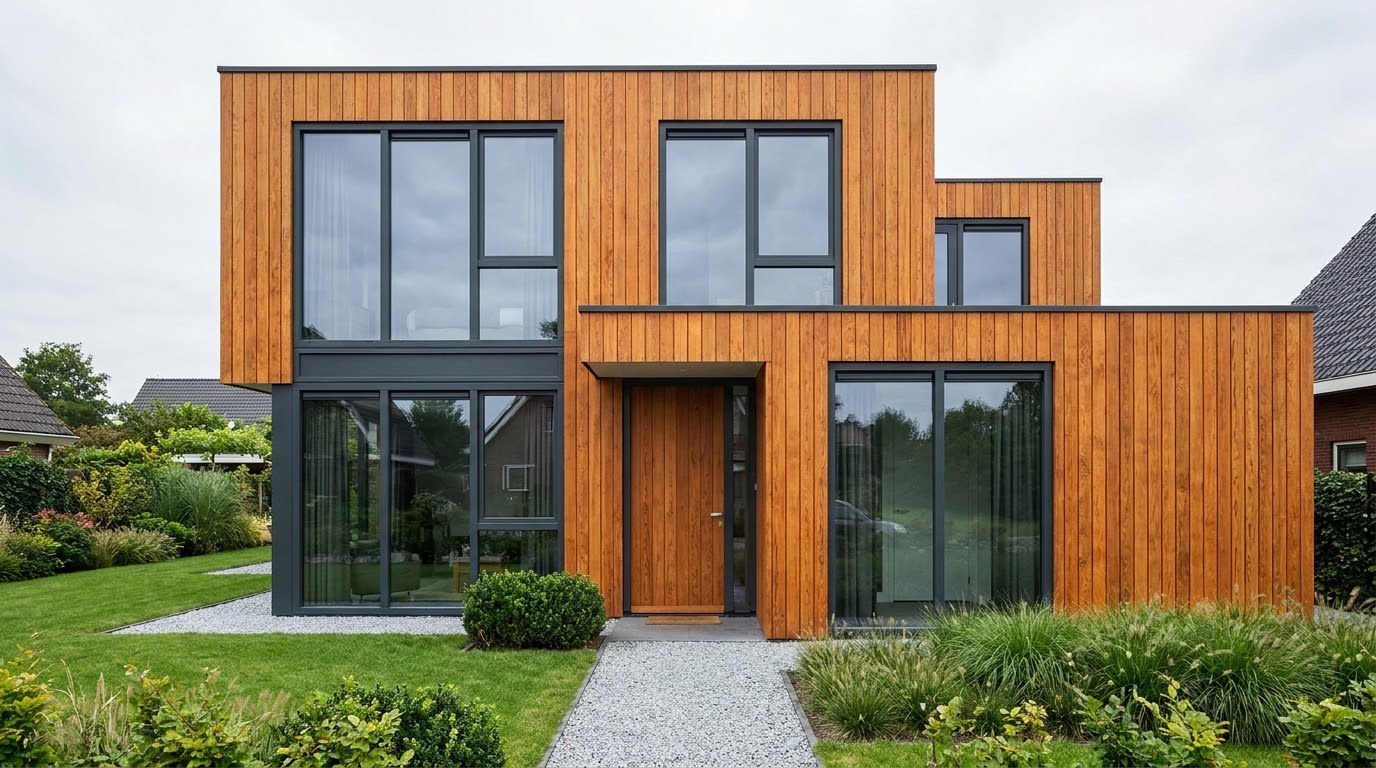
Larch cladding is one of the most popular uses of this type of timber, as it can be used untreated and weathers beautifully and evenly on a façade without overhangs.
Larch is available in various profiles: rhombus or trapezium battens for an open, modern façade; Swedish clapboard and channel siding for a classic, closed appearance; and vertical sections with a shadow joint. The same basic rules apply to the profile and installation as for other types of timber cladding:
- Install on a ventilated battens system, leaving space for air to circulate behind the boards.
- Use stainless steel screws or nails; ordinary steel fixings may cause dark stains.
- Protect the end grain and ensure there is a gap of at least a few centimetres between the timber and ground level or the roof surface.
- Allow the timber to acclimatise before installation, so that it does not shrink or swell immediately after being fitted.
You can read more about profiles, timber types and installation in our guide to timber cladding.
Leave it to weather or treat it?
Untreated larch wood weathers under the influence of UV light and rain, developing a silver-grey patina within a few years. This is not rot, but a superficial discolouration of the upper wood fibres.
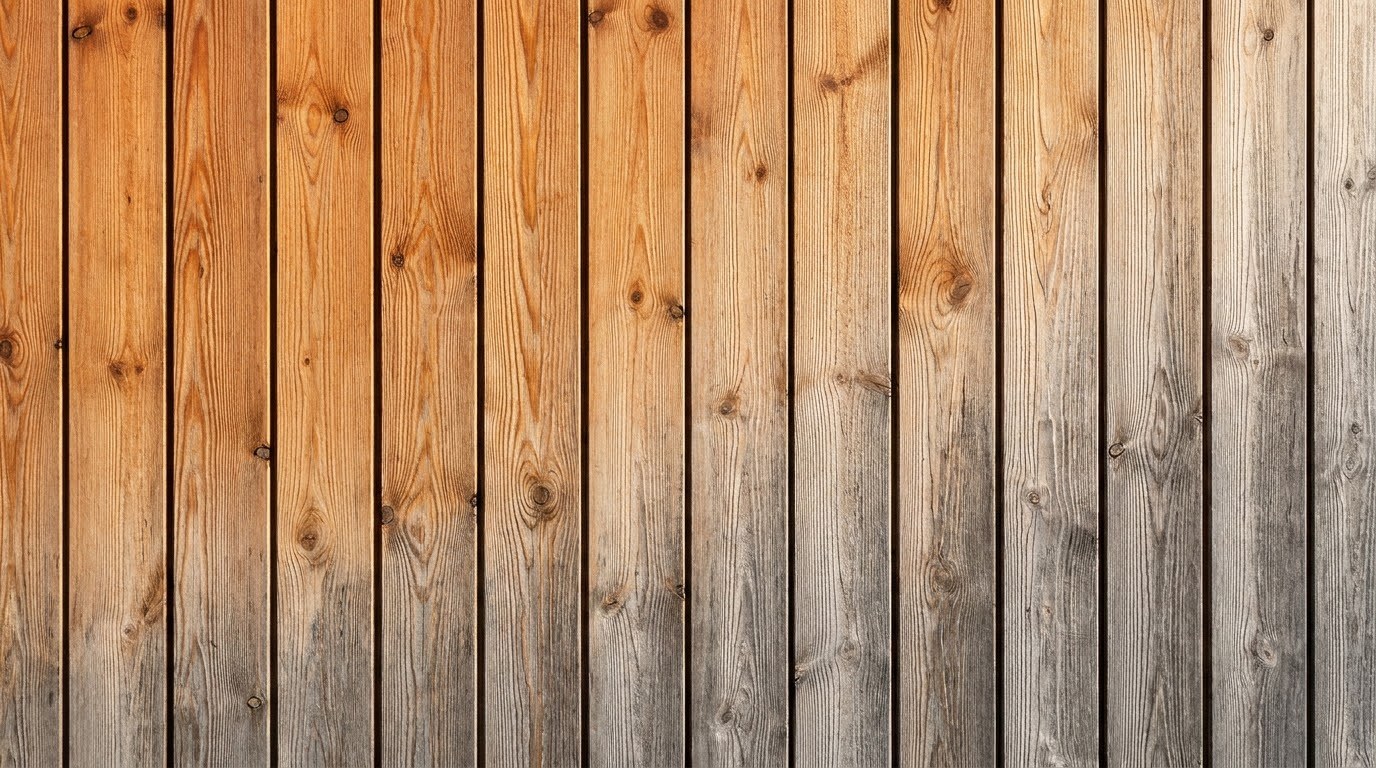
The wood does not weather at the same rate everywhere. Sections under a roof overhang or facing north remain brown for longer than those exposed to full sun and rain. On a façade with many overhangs, this can result in a patchy appearance. If you want an even colour, you have two options:
- Ageing stain or pre-aged larch: gives an immediate grey tint, so that the difference between sheltered and exposed areas is less noticeable.
- Clear stain or oil with a UV filter: retains the warm colour for longer, but requires periodic maintenance, on average every few years.
Opaque painting is less common with larch. Due to its high resin content, resin can seep out, particularly around knots and in warm weather, and this shows up as stains or sticky droplets through the paint layer. Sawing and planing tools also become contaminated with resin more quickly.
What should you look out for when buying larch?
The quality of larch varies considerably from one supplier to another, and these differences determine how long a façade will retain its attractive appearance. When ordering, pay particular attention to the following points:
- Sapwood-free or with sapwood: sapwood-free larch consists solely of heartwood and is more durable and stable. Pieces containing sapwood are cheaper, but more susceptible to mould and warping.
- Grading and knots: a grade with few knots gives a more uniform appearance and reduces the risk of resin seepage. Large or loose knots may fall out over time.
- Planed or finely sawn: finely sawn timber has a rougher surface that absorbs stain better and weathers more evenly. Planed timber has a sleeker, more modern appearance.
- Moisture content: well-dried timber shrinks less after installation. Ask about the moisture content on delivery, particularly for components with narrow joints.
- Origin and certification: ask for an FSC or PEFC certificate and for details of the country of origin. This provides an indication of the density of the timber and the traceability of the supply chain.
If you’re ordering from a timber merchant, ask for a few individual pieces as samples. That way, you can see what the wood looks like untreated and how a stain or oil will look on your façade.
Larch or hardwood: which is best suited to which part of the façade?
Larch or hardwood is primarily a choice depending on the specific part of the façade: fixed, ventilated sections are perfectly suitable for larch, whilst moving parts and those to be painted with a covering coat may require a dimensionally stable hardwood.
| Facade cladding | Larch | Hardwood (FSC) |
|---|---|---|
| Cladding | Highly suitable, even when untreated | Suitable, more expensive |
| Fence, pergola | Suitable | Suitable |
| Slats and sunshades | Suitable where there is good ventilation | Suitable |
| Shutters (hinged and sliding shutters) | Less suitable: warping, resin seeping through paint | Highly suitable: retains its shape well and is easy to paint |
| Window frames and doors | Only high-quality, laminated larch | Highly suitable |
Shutters are the clearest example. A shutter is hinged at two points, must close precisely within the window frame opening for many years, and is usually painted with an opaque finish to match the façade colour. The behaviour of sapwood and resin exudation work against this. That is why Shutters Inc. manufactures wooden shutters as standard from Meranti, pine and Merbau, with Bankirai, oak and red cedar available on request.
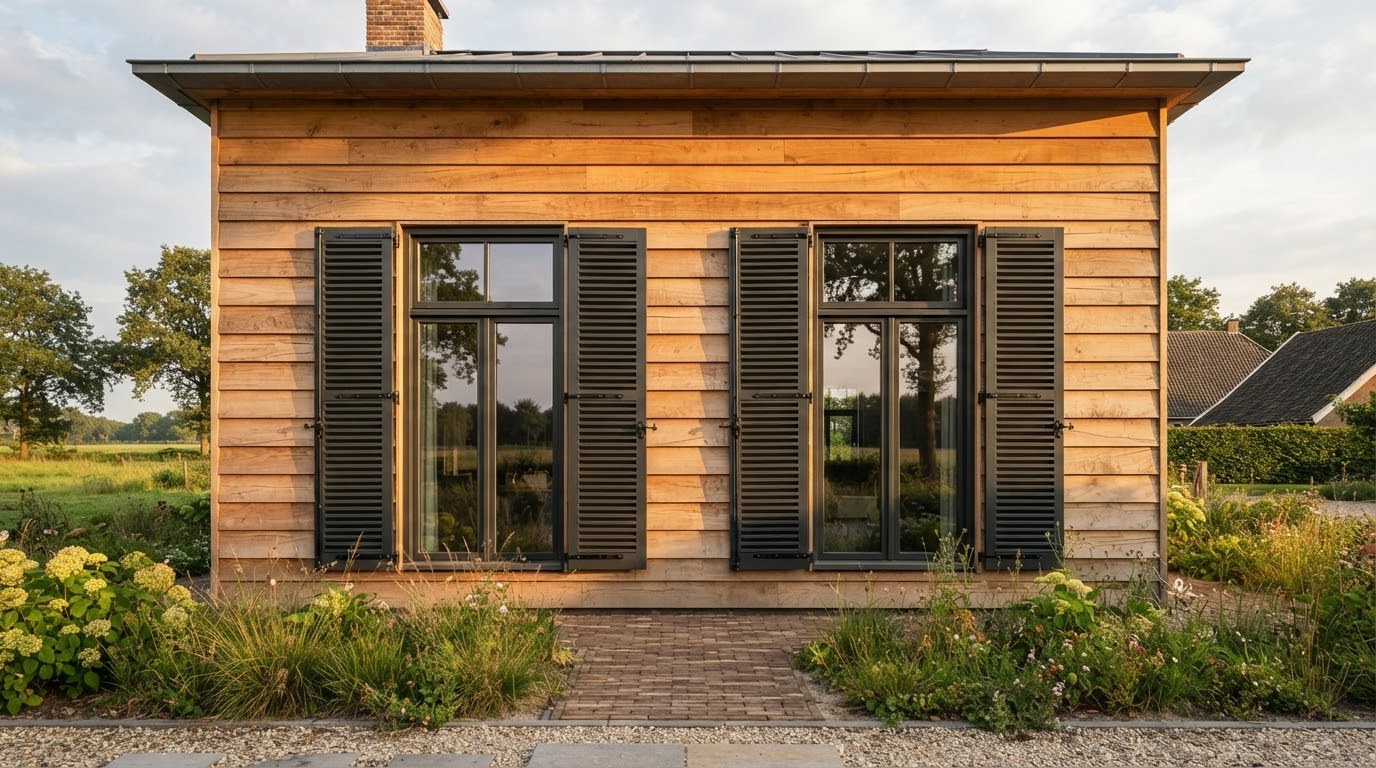
A popular combination is therefore: a façade in untreated or weathered larch, with painted hardwood shutters in a dark colour as an accent. The warm or grey wood and the sleek, coloured shutters complement each other perfectly. Are you opting for fixed wooden slats on the windows instead of shutters? Then read our article on wooden slats on the façade.
Is larch a sustainable choice?
Larch is a sustainable choice when it is FSC- or PEFC-certified and the transport distance is kept to a minimum. European and Dutch larch have a smaller carbon footprint than timber sourced from further afield, whilst Siberian larch involves a long transport route and its origin is more difficult to verify.
Milieu Centraal advises that, when using timber for outdoor applications, you should always look for a certification mark such as FSC or PEFC and, where possible, choose European timber. For components that need to retain their shape, such as shutters, certified hardwood remains the responsible choice: a shutter that lasts for decades does not need to be replaced prematurely.
Frequently asked questions
Is larch timber suitable for outdoor use?
Yes, larch timber is suitable for outdoor use above ground level. It falls into durability classes 3 to 4 and, if left untreated and well ventilated, will last for around 10 to 15 years. It is not suitable for use in contact with the ground or in permanently damp conditions.
What is the difference between European and Siberian larch?
Siberian larch grows more slowly in a cold climate and is therefore denser, at around 650 kg/m³ compared with 470–590 kg/m³ for European larch. European larch usually has more knots and a shorter transport route.
Does larch wood turn grey?
Yes, untreated larch turns silver-grey within a few years due to UV light and rain. If you wish to retain its warm colour, treat the wood with a transparent stain or oil containing a UV filter and repeat this periodically.
Can you paint larch wood?
It is possible, but it is rarely done. Larch contains a lot of resin, which can seep through an opaque coat of paint, particularly around knots and when exposed to heat. A transparent stain or weathering stain is more commonly used on larch than opaque paint.
Is larch better than Douglas fir?
Larch and Douglas fir are similar: both are softwoods in durability classes 3 to 4 and suitable for cladding and garden timber. On average, larch is slightly denser and contains more resin, whilst Douglas fir is slightly lighter. The choice depends mainly on appearance, profile and availability.
Can I have wooden shutters made from larch?
Larch is less suitable for shutters, as the wood’s tendency to warp and the exudation of resin can be detrimental to a moving, solidly painted section of the façade. Shutters Inc. manufactures wooden shutters as standard from Meranti, pine and Merbau; Bankirai, oak and red cedar are available on request.
Would you like wooden shutters to match your larch façade? Request advice and a quote with no obligation — we’ll usually get back to you within 24 hours. Request a quote
In brief — Larch timber | Shutters Inc.
- What: resinous softwood, European (Larix decidua) or Siberian (Larix sibirica)
- Durability: Class 3–4; untreated above ground approx. 10–15 years
- Density: approx. 470–590 kg/m³ for European larch, up to approx. 650 kg/m³ for Siberian larch
- Appearance: warm orange to reddish-brown; when left untreated, it weathers to a silvery-grey
- Best uses: cladding, fences, pergolas, slats
- Less suitable for: shutters and work requiring a full coat of paint, due to warping and resin content
- Sustainable: choose FSC- or PEFC-certified larch, preferably European or Dutch larch
- Shutters Inc.: wooden shutters available as standard in Meranti, pine and Merbau; Bankirai, oak and red cedar on request — in-house factory in Haaksbergen