The best timber for outdoor use has a high durability rating, retains its shape and is suitable for the intended application. For a fence, Douglas fir or larch will suffice. For façade elements that move and need to remain closed for years on end — shutters, window frames, doors — FSC-certified hardwoods such as Merbau, Bankirai or Meranti of the right quality are the strongest choice. Modified timber is a good alternative for those who want European timber.
What makes timber suitable for outdoor use?
Wood used outdoors is exposed to rain, frost, sun and mould. Whether a type of wood can withstand these conditions is indicated by its durability class: a European classification ranging from 1 (very durable) to 5 (not durable). The class indicates how long untreated timber will last before it is attacked by mould.
| Durability class | Description | Approximate lifespan of untreated timber used outdoors* |
|---|---|---|
| 1 | Highly durable | 25 years or more |
| 2 | Sustainable | 15–25 years |
| 3 | Moderately durable | 10–15 years |
| 4 | Not very durable | 5–10 years |
| 5 | Not durable | Less than 5 years |
Durability is not the only criterion. Two other properties determine whether timber is suitable for a specific application:
Dimensional stability — the extent to which the timber shrinks and swells as humidity levels fluctuate. This isn’t a problem for a fence; however, it is for a shutter that needs to fit exactly into a window frame opening.
Density and hardness — how well the timber withstands dents, wear and tear, and the weight of fittings. Hinges and fastenings must remain securely fixed in the timber for years to come.
Weather-resistant timber is therefore not simply ‘timber that can withstand rain’: it is timber whose durability, dimensional stability and hardness are suited to the outdoor use you have in mind.
A comparison of types of timber for outdoor use
There are three main groups of timber for outdoor use: hardwood, softwood and modified timber.
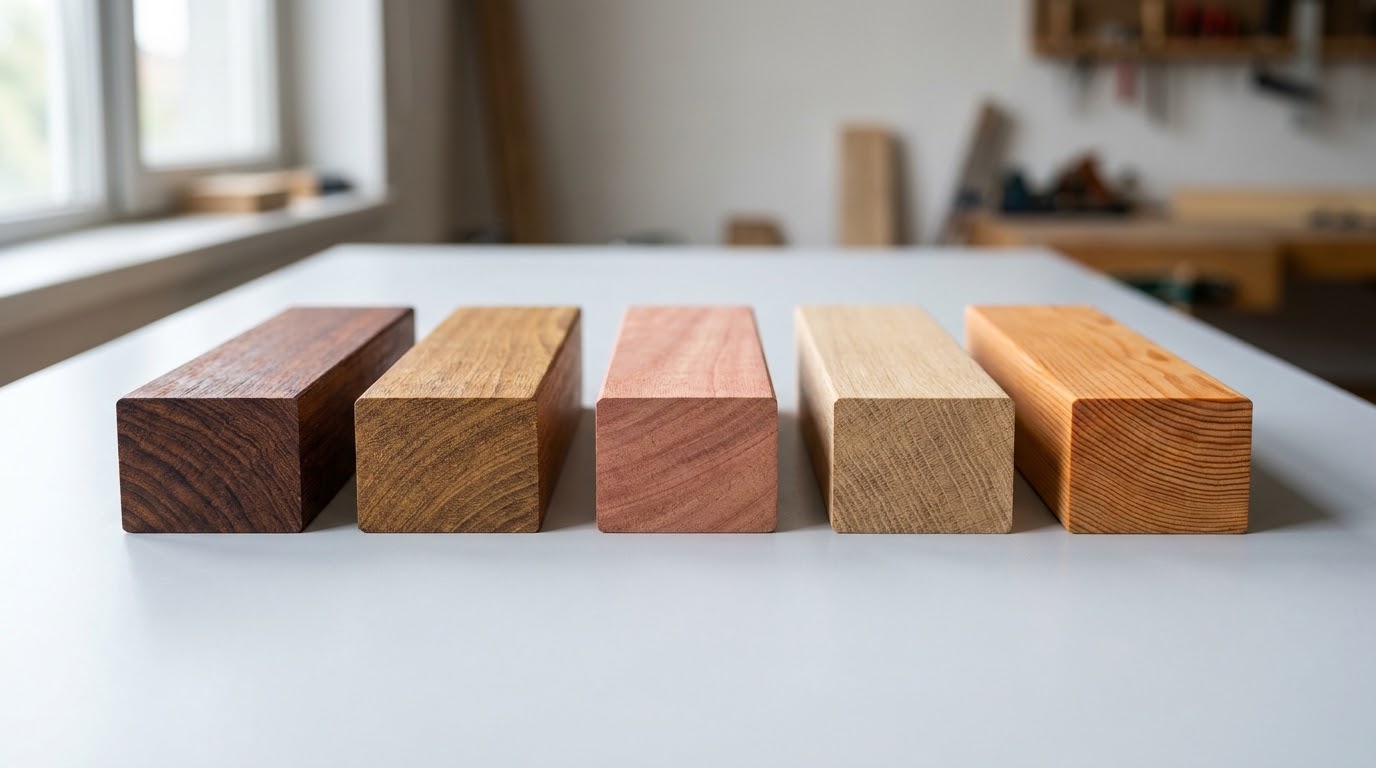
Hardwood comes from deciduous trees and generally has a high density and natural oils that resist moisture and mould. Tropical species such as Merbau and Bankirai are among the most durable types of timber available in the Netherlands. European oak is also durable (class 2), but is more prone to warping when exposed to changes in humidity.
Softwoods such as Douglas fir, larch and spruce are lighter, cheaper and easy to work with. Douglas fir and larch are moderately durable and popular for fences, canopies and cladding. Spruce and pine are only suitable for outdoor use once they have been treated.
Modified timber is softwood that has been made durable and dimensionally stable through heat treatment (thermowood) or a chemical process such as acetylation (Accoya). It combines European origin with a high durability class.
| Type of wood | Group | Durability class | Dimensional stability | Typical outdoor applications |
|---|---|---|---|---|
| Merbau (FSC) | Tropical hardwood | 1–2 | Very good | Shutters, window frames, cladding, decking |
| Bankirai (FSC) | Tropical hardwood | 1–2 | Good | Shutters, decking, cladding |
| Meranti (FSC, appropriate grade) | Tropical hardwood | 2 | Good | Shutters, window frames, doors |
| Oak | European hardwood | 2 | Moderate | Facade cladding, structures and shutters available on request |
| Western red cedar | Softwood | 2 | Good | Facade cladding, shutters on request |
| Accoya / thermally treated timber | Treated | 1–2 | Very good | Cladding, window frames, shutters |
| Larch | Softwood | 3 | Moderate | Facade cladding, fencing |
| Douglas fir | Softwood | 3 | Moderate | Fences, canopies, cladding |
| Spruce / pine (impregnated) | Softwood | 4 (untreated) | Moderate | Garden timber, fencing, posts |
Please note regarding Meranti: this is a trade name for a group of timber species of varying quality. Only Meranti with durability class 2 is suitable for outdoor use. Always ask about the class when purchasing — a low price may indicate a quality that will deteriorate quickly when used outdoors.
Which timber is best for which application on the façade?
Advice for the garden differs from advice for the house. A fence is allowed to expand, warp and be replaced after ten years. A cladding element is not: it must fit properly, seal well and last for decades.
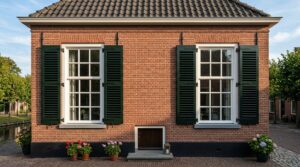
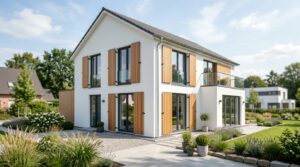
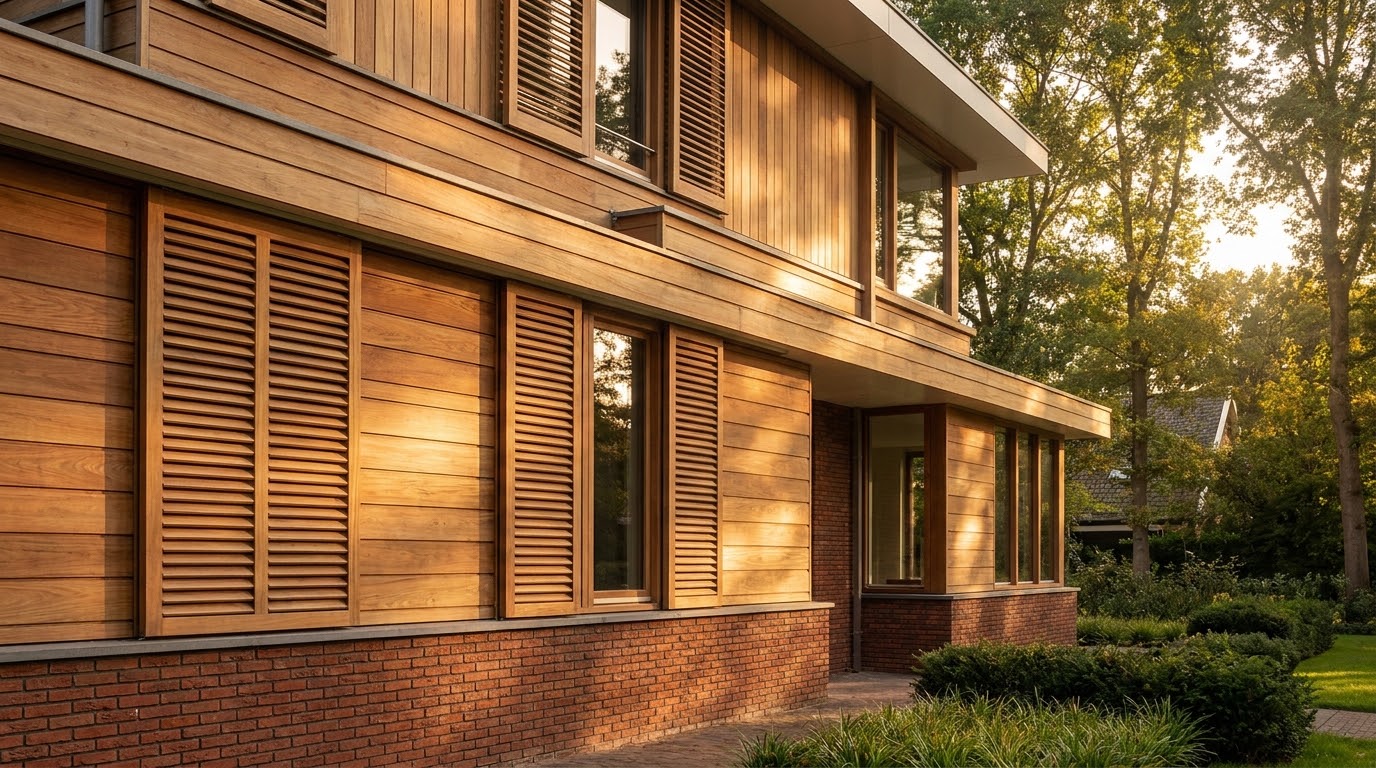
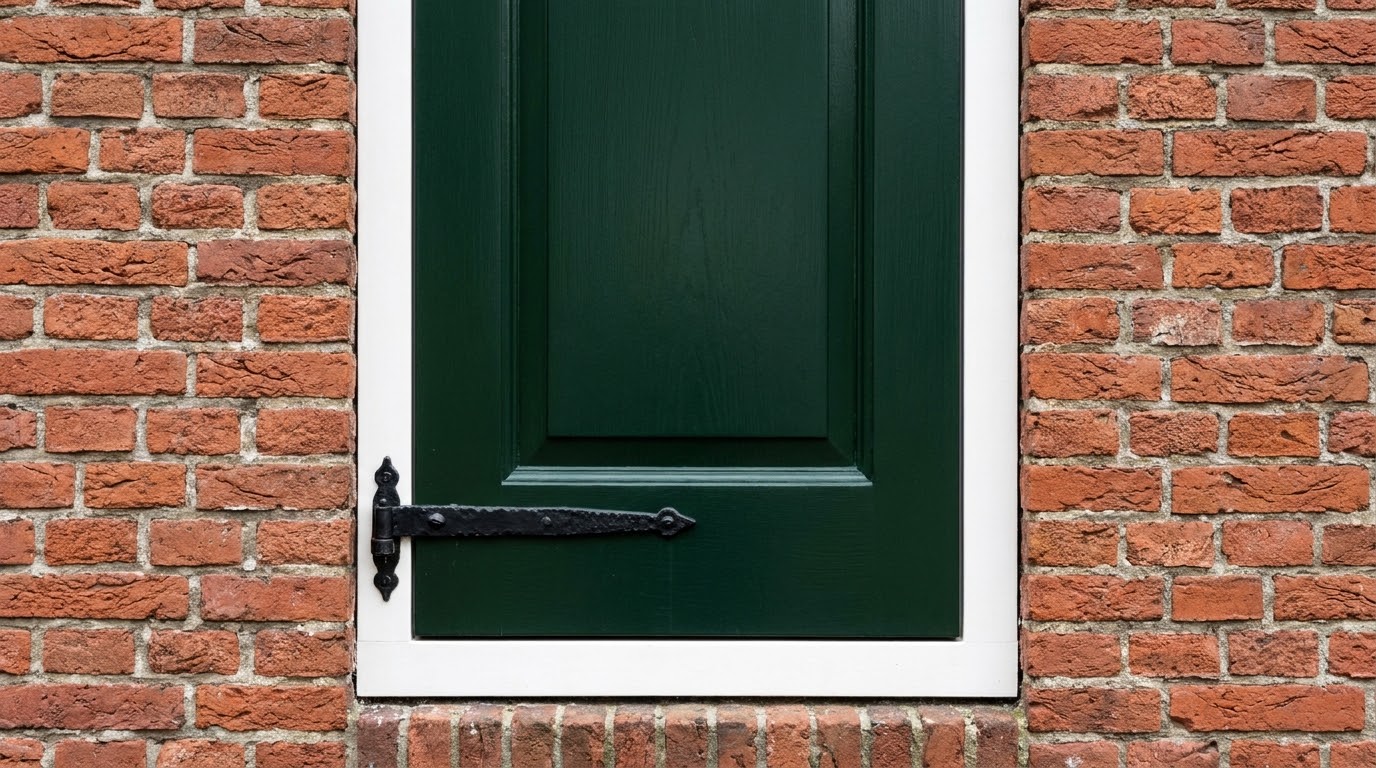
Window shutters — The most demanding element of a façade. A shutter is mounted on hinges, must fit precisely into the window frame opening and supports the weight of the fittings. Choose hardwood or modified timber in class 1 or 2 with good dimensional stability. At Shutters Inc., wooden shutters are manufactured as standard in FSC-certified Meranti, Merbau or Bankirai; oak and red cedar are available on request.
Cladding — Slightly less demanding, as the boards do not move and are ventilated on a substructure. As well as hardwood, larch, Douglas fir, red cedar and thermally treated timber are also good choices here, provided that weathering or periodic maintenance is acceptable. See our comprehensive guide to timber cladding.
Window frames and external doors — Dimensional stability is crucial here: a window frame that warps causes draughts and windows that stick. Meranti Class 2, Merbau and Accoya are the standard choices in Dutch window frame construction.
Decking and garden timber — Hardness and wear resistance are more important here than dimensional stability. Bankirai and Merbau are popular; Douglas fir and treated pine are budget options.
| Application | Key requirement | Recommended | Less suitable |
|---|---|---|---|
| Window shutters | Dimensionally stable + durable + suitable for fittings | Merbau, Bankirai, Meranti Grade 2, Accoya | Spruce, pine, Douglas fir |
| Cladding | Durable + ages beautifully | Hardwood, larch, red cedar, thermally treated timber | Untreated pine |
| Window frames / doors | Dimensionally stable | Meranti Grade 2, Merbau, Accoya | Larch, Douglas fir |
| Patio | Hard + durable | Bankirai, Merbau | Soft coniferous woods |
| Fencing / garden timber | Price + reasonably durable | Douglas fir, impregnated spruce | — |
Why dimensional stability matters for shutters and window frames
Wood absorbs moisture from the air and releases it again. As a result, it shrinks during dry periods and swells during wet ones. In the case of a shutter 50 centimetres wide, a timber species with high dimensional variation can change by several millimetres between summer and winter — enough to cause a shutter to jam or, conversely, to leave a gap.
Dense hardwoods and modified timber are significantly less prone to warping. The construction also plays a role: a well-made shutter is made from kiln-dried timber with joints that accommodate movement. In the case of a panel shutter, for example, the panel is suspended within the frame, allowing it to move without distorting the frame.
The finish also plays a part: a well-maintained coat of paint limits moisture absorption. If you neglect your shutters, even hardwood will warp more and eventually crack. See our maintenance guide for wooden shutters for the correct maintenance schedule.
Tropical FSC-certified hardwood or European timber?
A fair question that is being asked more and more often. Milieu Centraal recommends choosing European hardwood or modified timber wherever the application allows, and always buying new timber with a sustainable forest management certification, such as FSC or PEFC.
Practical considerations:
Tropical FSC-certified hardwood — Highly durable and dimensionally stable without chemical treatment, it will last for decades. The FSC label guarantees that the timber comes from responsibly managed forests. Downside: longer transport distances.
European hardwood (oak) — Short supply chains, durability class 2. Expands and contracts more than tropical hardwood, which requires extra care in construction and maintenance, particularly for precision-fitted elements such as shutters.
Treated timber — sourced from Europe, offering high durability and good dimensional stability. Generally more expensive to purchase.
A long service life is in itself a sustainability argument: a shutter that lasts thirty years does not need to be replaced after ten years. The responsible choice is therefore always certified timber that is suitable for the application — whether it is tropical or European.
Want to apply this to your façade straight away? Take a look at our bespoke wooden exterior shutters and window shutters, compare wood directly with low-maintenance aluminium and UPVC shutters, or read our guides on larch timber, wooden cladding and the maintenance of wooden shutters. Request a no-obligation consultation via our quote form.
Frequently asked questions about timber for outdoor use
What is the best timber for outdoor use?
There isn’t just one best type of timber: it depends on the application. For shutters, window frames and doors, dimensionally stable hardwoods such as Merbau, Bankirai and Meranti Class 2, or modified timber, are the best choice. For fences and garden timber, Douglas fir, larch or treated pine will suffice.
Which type of timber lasts the longest outdoors?
Timber grades in durability class 1, such as Merbau and modified timber like Accoya, will last for 25 years or more above ground when left untreated. With proper maintenance, hardwood cladding can last considerably longer.
Which type of timber doesn’t rot?
No timber is completely rot-proof, but hardwoods in durability classes 1–2 and modified timber are highly resistant to mould. Rot mainly occurs where water collects: good detailing and maintenance are just as important as the type of timber.
Is Meranti suitable for outdoor use?
Only Meranti with durability class 2. Meranti is a collective term for timber of varying quality; lighter grades are less durable. Always ask for the class and the FSC certificate.
Does hardwood need to be treated for outdoor use?
For durability, treatment is not strictly necessary for Class 1–2 hardwoods, but for façade elements such as shutters and window frames, the timber is almost always painted or stained. This limits moisture absorption and movement and provides the desired colour. Untreated timber weathers under the influence of UV light.
What is the cheapest timber for outdoor use?
Impregnated spruce, pine and Douglas fir are the most cost-effective options. They are suitable for garden timber and fences, but due to their limited dimensional stability, they are less suitable for bespoke façade elements such as shutters.
Are you unsure which type of timber is best suited to your shutters or façade? Ask for advice and a quote with no obligation — you’ll usually hear from us within 24 hours. Request a quote
In brief — Timber for outdoor use | Shutters Inc.
- Durability class: 1 (highly durable) to 5 (not durable) — choose classes 1–2 for façade elements
- Hardwood: Merbau and Bankirai (classes 1–2), Meranti (class 2 only), oak (class 2)
- Softwood: Douglas fir and larch (class 3) — suitable for fencing and cladding, less so for shutters
- Modified timber: thermally treated timber and Accoya — European, sustainable and dimensionally stable
- Shutters and window frames: dimensional stability is key — hardwood or modified timber
- Sustainable: always use FSC- or PEFC-certified timber, suitable for the application
- Shutters Inc.: shutters supplied as standard in FSC-certified Meranti, Merbau or Bankirai; oak and red cedar available on request — in-house factory in Haaksbergen